
The State of Reuse in Canada
They’re definitely not a state, but they definitely have reuse!
Seventeen federally funded reuse or reduction-focused projects, reuse at FIFA World Cup fan events, 11-plus reuse service providers nationwide, multiple municipalities enacting or exploring citywide reuse systems and policies… When it comes to reuse, Canada is onto something.
What’s their secret sauce?
Is it their national single-use plastic prohibition regulations? Their long-standing extended producer responsibility (EPR) laws that make clear the producer’s obligation to create less waste? A groundswell of community initiative?
The answer is “yes, and…” a combination of factors that are enabling reuse to take off in Canada. And though it is a unique recipe, there’s still much to learn and apply to reuse systems everywhere else.
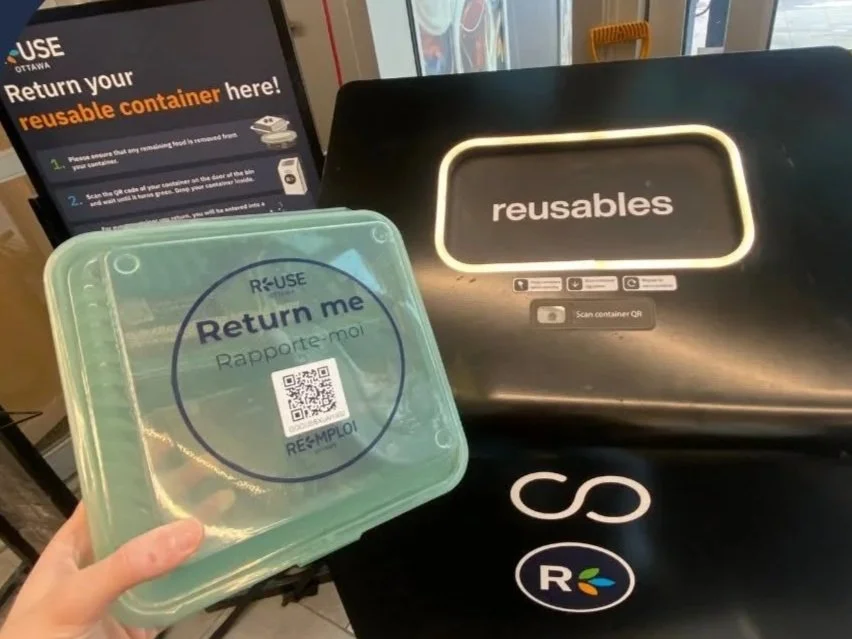
Reuse Ottawa ran a citywide reuse pilot from 2024-2025 that is now becoming a permanent project. (image: Reuse Ottawa)
Catalyzing Forces for Reuse
Support for reuse in Canada is coming from multiple directions, providing a solid foundation on which to build lasting systems.
For starters, public support is strong. Even though the national plastics ban is being contested in court, 82% of Canadians still support it — which has led cities like Toronto to go ahead with their own plastics reduction and reuse programs. And according to Environment and Climate Change Canada (ECCC), 89% of Canadians currently participate or are open to participating in a reuse or refill system.
Regardless of the status of the national law, ECCC still operates on a mandate to reduce plastic waste and pollution by advancing science, policy, and market innovation. Key to their ability to catalyze reuse is the fact that they fund projects nationwide — and we all know funding is a primary pain point in getting reuse off the ground.
“The collaborative approach really means that the initial stakeholders feel ownership of the system, and they want to make it a success.”
Meanwhile, municipalities like Banff, Toronto, Ottawa, and Victoria (to name a few) are contending with their waste issues at the local level. Seeing the popular support for reuse, backed by data and evidence from ECCC studies and other global examples, these cities are initiating reuse practices and policies to address the problem upstream — rather than pouring more taxpayer dollars into recycling and waste management. While many of their projects received federal funding, they were spurred by local action and often have carried on and/or have been supplemented by other sources outside of ECCC’s seed funding.
Another huge catalyst is playing out — literally — in the sports and entertainment sector. Venues including Rogers Stadium and RBC Amphitheater in Toronto, BC Place in Vancouver, and Save-on-Foods Memorial Center in Victoria have all switched to reusables. The operators behind these venues all had strong corporate sustainability commitments, and the organizations advocating for reuse have realized that sports and entertainment venues are the ideal sector to start building out reuse. Add to the mix a uniformly enthusiastic fan response, and these venues are committed and ready to scale.
What’s Working?
Though not every pilot has turned into a permanent piece of reuse infrastructure, it’s clear that reuse in Canada is here to stay — and grow. So they must be doing something right. A few somethings, actually.
-
Hands down, the most notable factor driving the success in Canada is an emphasis on collaboration, partnerships, and stakeholder engagement. ECCC — who themselves identify stakeholder engagement and collaboration as a pillar of their multi-lateral approach to enabling reuse systems — has also observed a marked uptick in collaboration among major companies. Take, for example, the Reuse City Canada Project, a reuse in retail project launching in Ottawa later in 2026.
The retail project will be the second citywide reuse system to launch in Ottawa, following Reuse Ottawa, which ran as a pilot between 2024-2025 and is now ramping up to a permanent project. The foundation for Reuse Ottawa’s success? Thorough stakeholder engagement. The pre-compettive project brought together major grocery retailers to design a deli takeout system. A year in, return rates are between 95-98%, and the pilot is on its way to becoming an enduring project. As Shannon Lavalley of Circular Innovation Council, which coordinated the project, notes, “the collaborative approach really means that the initial stakeholders feel ownership of the system, and they want to make it a success.”
Corporate cooperation is one way to get things done. Coalitions — networks of smaller community groups and organizations — are also moving the dial on reuse. Reusable Toronto, for example, is comprised of 46 endorsing groups, ranging from the community level, to national NGOs, to businesses and universities. Add research partners from University of Toronto and York University to the mix, and Toronto has been able to move forward multiple initiatives simultaneously. They even leveraged their research and case studies from reuse leaders already working in the city to highlight the opportunity to implement reuse at FIFA World Cup, for which Toronto is a host city.
Partnerships are already helping large venue operators succeed with reuse systems. Live Nation Canada reports that partnering with a reuse service provider to run their reuse systems means fewer operational shifts, especially back of house. And Save-on-Foods Memorial Center found a serendipitous partnership with the local bottle depot, which voluntarily separated out and returned misplaced reusable cups.
Municipalities are also partnering up to share notes on their reuse policies, providing insights on lessons learned and templates for policy language that others following in their wake can adopt and adapt. This approach is not as harmonized as a provincial or federal regulation would be — but it’s a start.
-
With the case for reuse only becoming stronger, and a proliferation of research and studies illustrating its success, new projects don’t have to start from scratch every time. But, a shift in operations is a big commitment, and successful projects in Canada (almost) all started with amassing the data and running a pilot.
With its thumb on the national pulse, ECCC was able to conduct a few comprehensive studies that projects around the country could draw from to get stakeholder buy-in or follow best practices. City-level studies like those run in Toronto help to fine-tune the case for localized needs and practices.
Even if stakeholders like the data and projections, they often need to see reuse in action — as a pilot — before fully committing to a scaled project. Pilots also help to work out the kinks before introducing a new system to thousands, or even millions, of fans or consumers. It doesn’t take long, though: BC Place followed a progressive scale-up from single-use aluminum cups, to pilots, to 100% reusables in short order. And after a two year pilot program, Reuse Ottawa is working on permanent expansion. (Notably, Reuse Ottawa conducted a study after their pilot to help create a roadmap for scaled reuse in other municipalities.)
One important exception to the “start with a pilot” concept — Live Nation found that in the two Toronto-based venues they run, Rogers Stadium and RBC Amphitheater, they knew working in volume would be the only way to mitigate the expense of implementing reuse. So they started large in order to create the volume to justify the investment.

Banff, Alberta implemented a Single-Use Reduction Strategy & Bylaw in 2024. (image: Town of Banff)
What Needs Improvement?
Forging the way into a new economic system means learning as you go. And though these Canadian projects are running off solid baseline data, research, and surveys, there are bound to be stumbling blocks along the way. The benefit being — we can all learn from them as reuse momentum spreads in the US and beyond.
-
Like nascent reuse systems everywhere, a few prevalent “chicken or egg” scenarios are playing out across Canada.
Most consistent — and persistent — is the funding conundrum. Reuse systems need up-front investment in order to operate at a scale that will ensure ROI — but investors want to see reuse at scale before they take the risk of investing. In short, as Travis Wong, Senior Director of Business Operations at Live Nation Canada points out, returns are better at volume, but volume is expensive.
One reason more projects have been able to get off the ground in Canada, however, is the seed funding available through ECCC. Many projects were able to continue on private capital after proving themselves in pilots funded by ECCC. Larger systems like in Ottawa are actively researching how to shift from a publicly funded pilot to a self-sustaining monetized system.
Another chicken/egg: while everyone recognizes the strongest systems require collaboration and partnership, projects themselves still tend to be siloed from one another. Because they are drawing from specific funding pools — and often competing for the same funding — and generally beginning as discreet pilots, collaboration and cross-pollination between projects is still relatively limited.
This is particularly true when it comes to shared infrastructure. In order for the reuse economy to truly scale, it must be built on shared, interoperable infrastructure. Ultimately, operators could also participate in pooled procurement, further driving down costs.
As it stands now, in Canada as elsewhere, reuse projects tend to stand alone. ECCC is helping to facilitate learnings between projects, which is the first step in the right direction, but even a national entity cannot connect the dots between all reuse initiatives.
-
Though Canada is revved up when it comes to reuse, certain conditions limit the pace of momentum, making it difficult to fully meet the moment.
For one, research timelines can inadvertently lengthen the runway to implementation. Though data and research provide essential baseline information, risk of redundancy is becoming more real as the body of reuse research exponentially increases. Another danger of siloed projects, particularly when tied to specific funding pools, is repeating similar research. The timeline required for funding, conducting, and publishing research can extend beyond the time of another project that could benefit from the same data.
On the flip side, not collecting enough data, or the right kind of data, from the start can impede a project later. Banff’s program wished they had collected more baseline data at the start of their single-use reduction bylaw in order to more accurately measure their success. Reuse Ottawa, meanwhile, is unable to track the success of incentive programs in boosting participation and return rates because individual participating businesses create their own (a pain point given that the question of if incentives work is a big one in the reuse movement).
Launching a successful program depends on not only just the right amount of the right data, but also on intentional planning. As Reuse Ottawa learned, city based pre-competitive models take a long time to design and launch — though they are more robust and enduring when they take the time to be thoughtful and thorough.
Policy also requires a delicate balance of timing considerations. Cities that pass single-use reduction ordinances need to give businesses a certain runway to comply. And as Marika Smith, Sustainable Waste Management Specialist in Victoria, BC points out — they don’t want to be punitive to businesses operating in a difficult economic landscape. Victoria rolled out an 18 month runway, while the Banff team wished they’d made theirs longer — though they made up for it by leaning on education instead of fines and enforcement for several months after the compliance period had begun.
ECCC acknowledges a general trend: the pace of government (especially at the federal level) is usually much slower than the pace of the economy or of reuse entrepreneurs trying to grow their businesses. Take Toronto for example, where Reusable Toronto and Toronto Environmental Alliance have been pushing forward initiatives to the best of their ability, but support from the multi-stage single-use reduction strategy and bylaw has lagged behind as city officials have pushed timelines due to other priorities.
For sports and entertainment venues, operational complexities can slow down initial implementation precisely because venues need to move very quickly when serving fans. Careful calculation is required to provide enough cups to fans without having excess sitting unused. And the unique features of each venue mean that there is no “one size fits all” standard. Rogers Stadium, for example, has quick turnover between shows and a very high volume of shows — 78, versus a North American average of 30, per season.
Up against these challenges, venues must get stakeholder buy-in for every project — and the sooner, the better. Upfront costs, infrastructure needs, the convenience and artificially low cost of disposables, and a propensity for recycling can cause risk averse venue operators and investors to hesitate. Fortunately, operators at Live Nation, Save-on-Foods Memorial, and BC Place (which is government owned) have sustainability commitments that internal champions are dedicated to seeing through.
It’s a good thing, too, because Canadians (and many others!) are beginning to see the limits of pilots and the need for more full-scale reuse systems. We’re starting to see what Marika Smith calls “pilot fatigue” and the need to scale up before we lose momentum and interest. ECCC agrees, conceding that while we still have a lot to learn from pilots, reuse systems work best when they are scaled and interoperable.
-
And reuse seems hard — or at least that’s the sentiment pilot and project operators and researchers come up against.
Public education is the critical component that can make or break a reuse system, according to operators. But at the same time, the more reuse is the default, and the easier the system is for the consumer to use, the less education is needed.
BC Place started their reuse system without any public education. Because reuse was the default option, though, they still saw good return rates (83%). When they implemented an educational campaign for both staff and fans, they saw their return rates jump by 5%.
“In order for the reuse economy to truly scale, it must be built on shared, interoperable infrastructure. ”

Rogers Stadium in Toronto has started serving beverages in reusable cups. They feature an average of 78 shows per season. (image: Rogers Stadium)
Lessons Learned
As Canadian projects overcome some all too familiar barriers, their lessons learned can help propel the broader movement.
“Launching a successful program depends on not only just the right amount of the right data, but also on intentional planning. ”
Besides creating an informed, data-driven pilot or project, much of the reason that so much research is conducted has to do with convincing stakeholders. Show them impressive numbers couched in verifiable analysis or case studies and they’ll bite, right? Maybe. But as Jennifer Barr from ECCC points out, testimonials and trends can be as strong or a stronger influence over decision makers. They want to hear from those who have come before that reuse really can deliver on its promises.
Venue operators across Canada can provide those testimonials (and do, in this webinar from PAC Global and the National Zero Waste Council). They prove out what the data tells us: it’s best to introduce reuse systems in closed-loop settings. Reuse for onsite dining requirements are one way to go about that — and many municipalities, like Toronto and Banff, start with this “low hanging fruit.” But as we know, the bigger the project (e.g., stadiums), the bigger the impact.
Still, there’s a “yes, and” at play here: small businesses are often also friends and neighbors who want to do right by the cities they live in. Reuse leaders who have spent significant time engaging small businesses have helped spur a larger mindset of reuse in their communities.
When scaling to citywide systems, the inherent complexity requires hands-on coordination in real time — across logistics, sanitization, container tracking, and retailer support. When the players are committed, as Ottawa is proving, this complexity can be navigated. (And navigated more and more smoothly as reuse tech increasingly optimizes operations.) Places like Ottawa, Banff, and beyond are also leveraging underutilized existing infrastructure — like wash facilities — to lower costs and environmental footprint.
Finally, while policy is not the only lever to activate reuse — and rolling out regulations can take a long time — policy can be greatly beneficial in aligning and harmonizing reuse systems.
As Matt Cooke, General Manager at Eventium Food Services, which services Save-on-Foods Memorial Centre, points out: real change comes when venue operators and policymakers are working toward the same ends. This is particularly true in Canada because often, municipalities own cultural venues while third parties operate them. Yet another iteration of the collaboration that makes reuse systems tick.
“Public education is the critical component that can make or break a reuse system, according to operators. But at the same time, the more reuse is the default, and the easier the system is for the consumer to use, the less education is needed. ”
Moving Forward Together
A reuse economy follows a different kind of structure. Not only is packaging produced and circulated differently, a non-linear and unconventional ecosystem and interconnected networks of experts make reuse run successfully.
Businesses, academia, nonprofits, government, and more all need to come together — sometimes to make the case to stakeholders needed to fortify this ecosystem, and sometimes to implement a robust and enduring reuse system. Standardizing practices, as PR3 is doing (with assistance in part from the Standards Council of Canada) goes a long way in keeping everyone aligned.
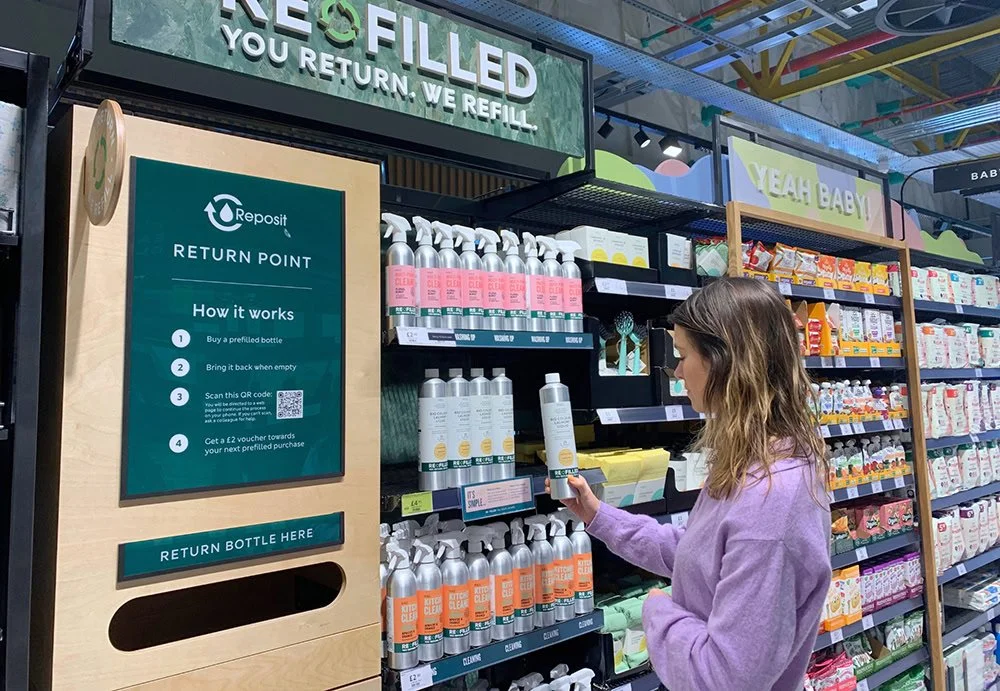
The Reuse City Canada project will be launching later this year in Ottawa. (image: Reposit)
Nonprofit or public entities are often key to facilitating these unconventional and sometimes unwieldy partnerships and collaborations. In Canada, numerous organizations — among them, ECCC, Toronto Environmental Alliance, Circular Innovation Council, and National Zero Waste Council — play a critical role as coveners and coordinators.
This coordination and collaboration is essential for any reuse project anywhere. So why is it working so well in Canada? Why are retailers motivated to work together pre-competitively? Why are venue operators jumping on the shift to 100% reusables without any particular regulatory pressure? Many factors are at play, of course, but broadly speaking — contentious (to industry) though it may be — the federal anti-plastics mandate reflects a broader commitment to and investment in reducing single-use waste. And out of that commitment arises reuse champions to carry the movement forward.
The circular economy is not just a concept in Canada — it’s an ethos that permeates an impressively broad swathe of the population. Especially impressive given that even Canada is still (currently) stuck with a single-use, throwaway culture as the social norm.
It’s an ethos to Upstream, too. As we’re watching and learning from our friends in Canada, we’re heartened that the most essential pieces of the reuse puzzle are replicable in the US and beyond.
Of course, the most critical piece is ongoing collaboration. Both ECCC and Upstream recognize that system change does not happen in silos. As we unite efforts across borders and sectors, and snap scattered pieces of the puzzle into place, the big picture of an enduring reuse economy will similarly snap into focus — and become reality.

Members of the Upstream and ECCC teams excited to work together on reuse. (image: Upstream)