FIFA World Cup: A Missed Opportunity or a Catalyst for Enduring Reuse?
Over 39 days, the FIFA World Cup 2026 stretched across three countries and 16 host cities. By FIFA’s own accounting, 6.8 million cumulative fans attended the games, consuming more than 4.6 million soft drinks and bottled waters and over 5.5 million beers during the tournament.
And zero of those refreshing beverages fans enjoyed under the sweltering summer sun were served in reusable cups.
What a huge missed opportunity, right?
Yes. But there’s another side to the story. Throughout the tournament, 13 FIFA Fan Festival locations operated for a combined 348 days and attracted over 9 million fans (yes, more than attended the games themselves).
The Fan Festivals offered a far larger opportunity for reuse, and several cities embraced it. Not only that, conditions offered by the Fan Fests and unofficial viewing parties were more conducive to truly moving the needle on reuse — toward establishing enduring systems that benefit the surrounding communities for far more than 39 days.
Bringing Reuse to the Top Takes a Loooonng Runway
FIFA is a multi-billion dollar international organization funded by tournament sponsorships. Unless you are an advertiser looking to invest, getting the ears of the key decision-makers in the upper echelons of the organization is pretty impossible. Even knowing who the key decision-makers are was a guessing game for those advocating for reuse.
Institutions — whether international behemoths like FIFA or hometown stadiums — often aren’t ready to dig in to exploring alternative systems and operations until a tangible decision point and deadline is in front of them. And when that tangible decision point involves waste management, it usually comes at the end — too late to implement a radically different way of managing waste.
Still, host cities tried. Representatives from Seattle Public Utilities started engaging with the Local Organizing Committee (LOC) three years in advance and tried to jump on an opportunity to liaise directly with World Cup headquarters about a year before the Games, though it fell through. And in June 2025, the Toronto Environmental Alliance (TEA) released “Kicking off with reusables: The opportunity of the FIFA World Cup 26™ for Canadian events,” outlining the benefits of shifting to reusable foodware at major sporting events and festivals in Canada, and the opportunity of the World Cup to kick off the shift.
While FIFA didn’t implement reuse at the games in Seattle or Toronto (or any host city) this year, the context of the World Cup meant more ears were open to discussions about reuse systems as a viable alternative to single-use waste than otherwise would have been. Seattle Public Utilities’ Ashima Sukhdev says that, even putting the question of reuse at the games aside, the buzz they created had its own significance. “Even though [the] World Cup is a once in a lifetime thing happening in our cities… it matters because of the resident outreach and impact and the exposure that the reuse movement got,” she says. From the Pacific Northwest to the tip of the Florida peninsula, reuse experts and advocates were able to get key conversations started.
Building an on-ramp rather than rocketing to the top with a tournament as specialized as the World Cup may not be all bad. One reuse service provider shared that, in the event their company had been hired to serve the World Cup games in their city, they would have been left with an inventory conundrum — needing to rapidly stock up on extra cups in a time of high tariffs and supply chain volatility, only to be left with excess at the end of the games. It could be enough to sink a nascent reuse service provider — the opposite of the enduring reuse economy we’re aiming for.
This conundrum points to a larger takeaway reported by reuse advocates in host cities. Namely, one-off, high profile events like the World Cup are great for sparking conversation and raising awareness, but localized, single-site, recurring events are better for implementing reuse systems. They provide ongoing contracts to service providers, allow time and space for testing and tweaking, and allow fans to adjust to and embrace new systems.
But We Need Reuse Now!
This is true! Reuse systems mitigate many of the urgent issues we are facing, from climate change to volatile global supply chains. Many community advocates and leaders know this, and many World Cup host cities seized the opportunity in whatever ways they could.
From official FIFA Fan Fests to unofficial fan events and watch parties, local activation led to impacts not only for fleeting fan bases but for community members, as well. With more local control, they were able to adapt to suit various event conditions and sizes, as well as budgets.
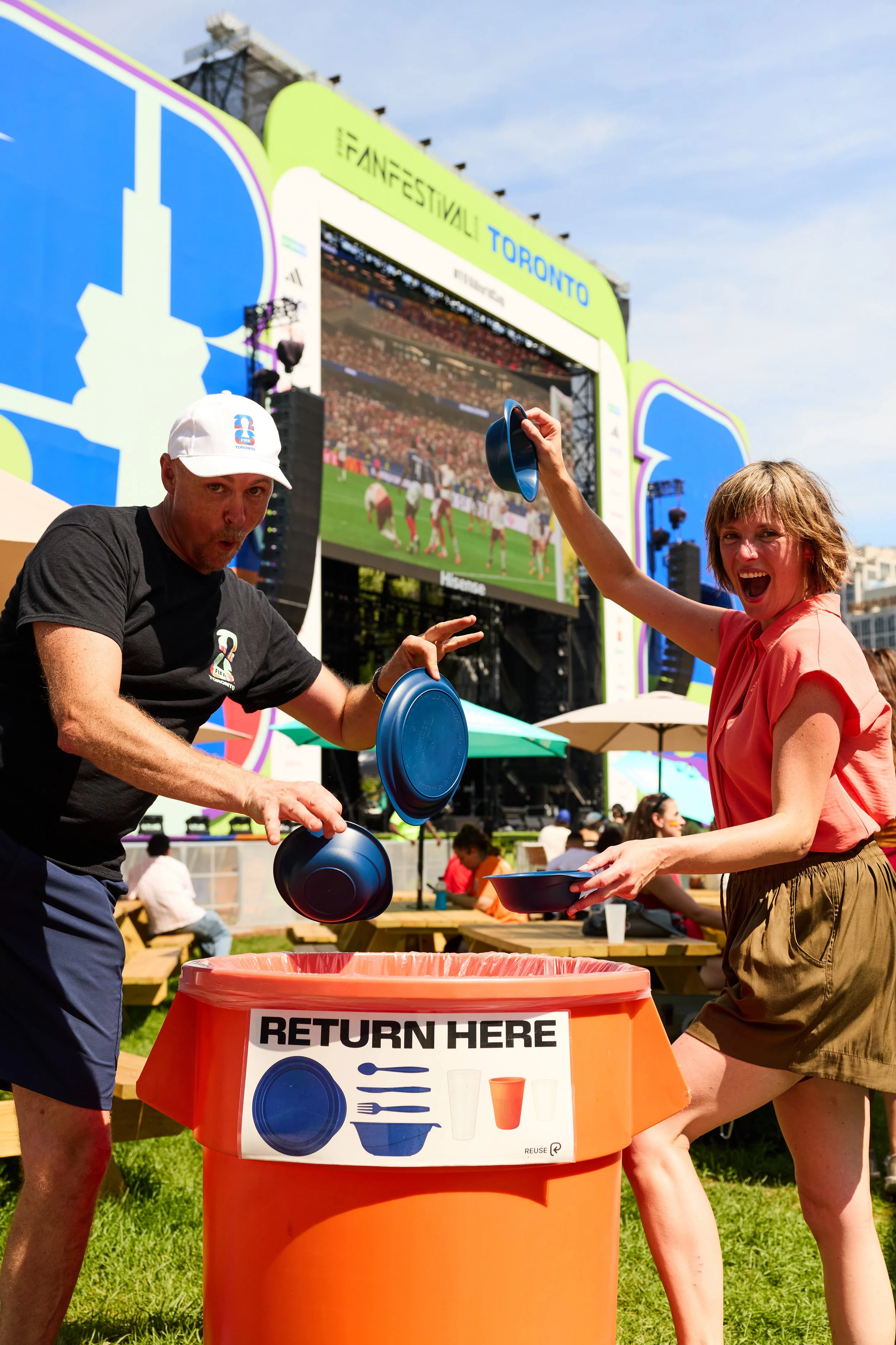
Muuse in Toronto (image: Bryton Garay)
Toronto hosted an official FIFA Fan Festival for 22 days at Fort York & The Bentway, outdoor public grounds that can accommodate 20,000 fans. Reuse service provider Muuse adapted their operational model to the specific requirements of the event and its partners, which meant serving only in the VIP areas. And while final event metrics have not been shared publicly yet, the program successfully deployed thousands of reusable cups, plates, bowls, and cutlery throughout the Fan Festival, while providing operational support as requirements evolved over the course of the event.
Beyond reducing single-use waste, their program demonstrated that a standardized reuse system can be successfully integrated into a complex, high-volume live event environment. “When the system is designed well, returning a cup or plate becomes just another natural part of the guest experience — and it can happen at scale,” says Scott Morrison, Muuse Development Partner, Canada.
Businesses around Toronto also hosted unofficial watch parties. Evergreen Brick Works, which was featured as a case study in TEA’s report, served on 100% reusable foodware for their watch parties.
Vancouver’s FIFA Fan Festival, meanwhile, was hosted in a 10,000-capacity open-air amphitheater at Hastings Park over 28 days. BrandLIVE, the Fan Fest production coordinator, knew they wanted reusables at the event and issued an RFP for reuse services. Local service provider ShareWares jumped on the chance to roll out reuse during the World Cup in Vancouver, seeing it as an opportunity to, as CEO Cody Irwin says, “showcase reuse on the world stage.”
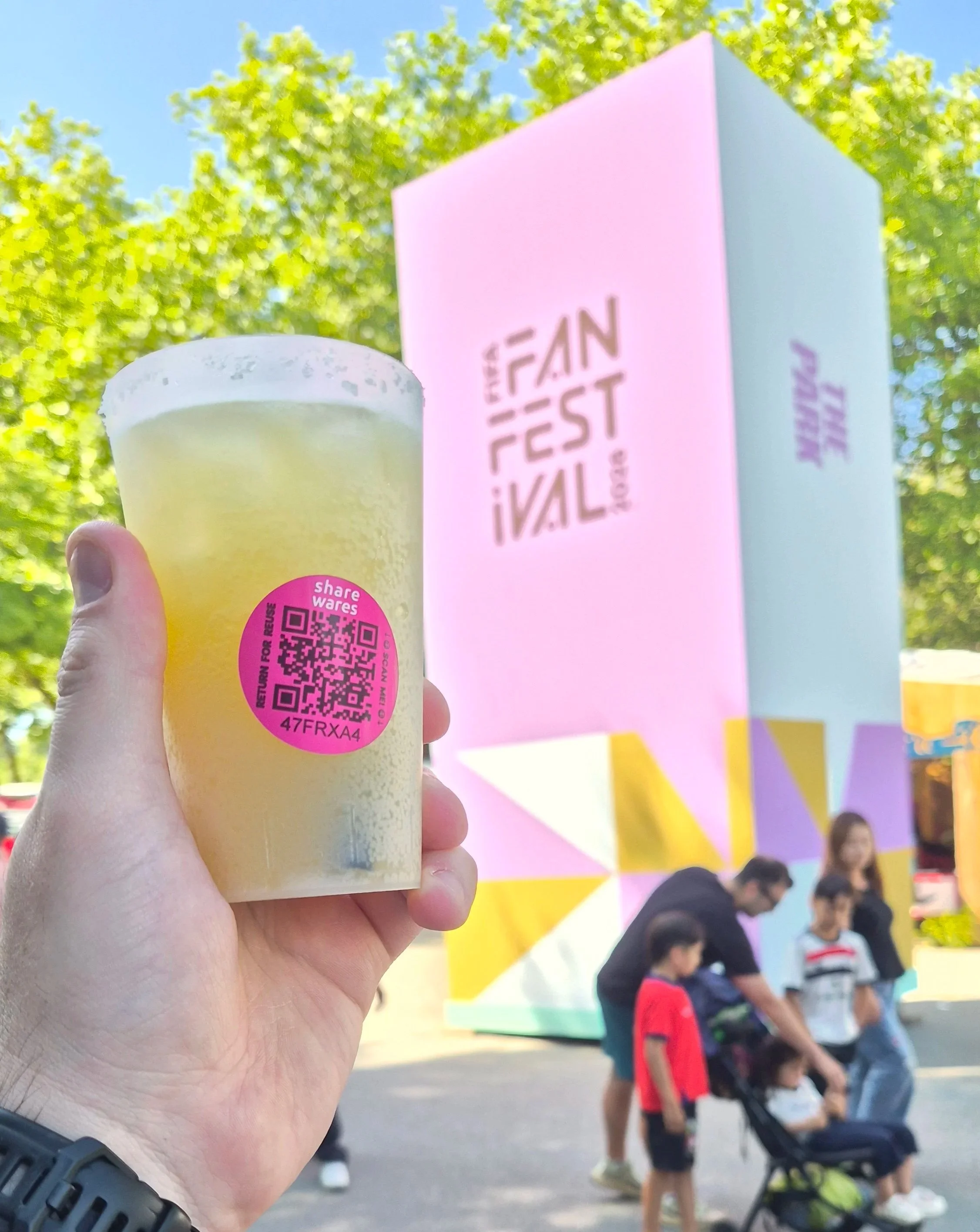
ShareWares in Vancouver (image: ShareWares)
In coordination with the concessions provider, a third party food service operator, and the local waste-pickers group Binners’ Project, ShareWares provided reusable cups site wide for mixed drinks, wine, coffee, and milkshakes — enjoyed not only by attendees but also the artists performing on stage. Throughout the Fan Fest, they displaced tens of thousands of single-use cups.
Irwin attributes the activation’s success to the fact that they were able to run a reuse system that worked much like the single-use systems people are familiar with. “The PNE team was on point, slinging drinks in reusable cups and managing collection bins, while the Binners’ Project served as the last line of defense, making sure the cups all came home,” he says. “It was a smooth and truly flawless execution by everyone involved.”

r.World in Miami (image: Debris Free Oceans)
British Columbia has a Single-Use and Plastic Waste Prevention regulation on the books, and events and stadiums in Vancouver often feature reusables. Not so in Miami, where reuse is nascent and faces many barriers. The biggest one? Miami does not have dishwashing infrastructure for large-scale events. And this event was indeed large: Miami’s Fan Fest hosted up to 30,000 attendees a day for 24 days. Undaunted, beverage sponsor Diageo worked together with service provider r.World and Fan Fest’s Sustainability Team, Ascendance Sustainable Events, to design a system that would work — starting with renting portable dishwashing units.
More creativity ensued in Miami. Because the World Cup is a memory-making experience, fans actively seek souvenirs — so at Fan Fest, the three branded cocktail cups were marketed as such. Unlike the souvenir cups at the World Cup games themselves (more on those later), these souvenir cocktail cups were durably made, so any that were left onsite were able to be collected, washed, sanitized, and put back into circulation at the Fan Fest.
Overall, the Miami project professionally washed and sanitized over 2,000 cups. At the end of the event, the remainder was donated to local community organizations that Ascendance Founder Vivian Belzaguy Hunter knew would actually keep using them again and again. The FIFA Fan Fest in Los Angeles’ Memorial Coliseum, serviced by Vytal, followed a similar souvenir cup recirculation model. While not a full-on reuse system, this approach to souvenir cups still prevented waste and provided an educational opportunity for back-of-house reuse operations.
While Seattle did not have an official FIFA Fan Fest, they had more autonomy to follow their municipal mission to be a zero waste city, hosting seven events of their own — working with Bold Reuse and other local partners to integrate reuse into all of them. With grant money from the LOC to help with expenses, for 22 days they hosted a large daily watch party at the Seattle Soccer House at Pacific Place Mall and additional fan events at Pier 58. Notably, Seattle Parks & Recreation organized neighborhood watch parties at four city parks, featuring food trucks serving in reusable foodware and accomplishing a 94%-98% return rate.
Additionally, while Seattle PrideFest is its own annual celebration (that also employs reusables), the LOC also designated the World Cup match that weekend as a “Pride Match.” In all, the reuse-featured events helped displace more than 20,000 single-use items.
Bold Reuse also supported local activations in Kansas City. While the official Fan Fest did not incorporate reusables, multiple independent watch parties throughout the greater Kansas City area did — likely inspired by the reuse systems residents are already accustomed to at venues like Arrowhead Stadium and CPKC Stadium.
“The World Cup gave us a different kind of proving ground,” Bold Reuse CEO Jocelyn Quarrell says. “What we learned is that a reuse system succeeds or fails on the small details: where a bin sits relative to a water station, whether signage survives a breeze, how clearly people understand what goes where. Every event like this sharpens the playbook for the next one, and that operational learning is just as valuable to us as the cups we collected.”
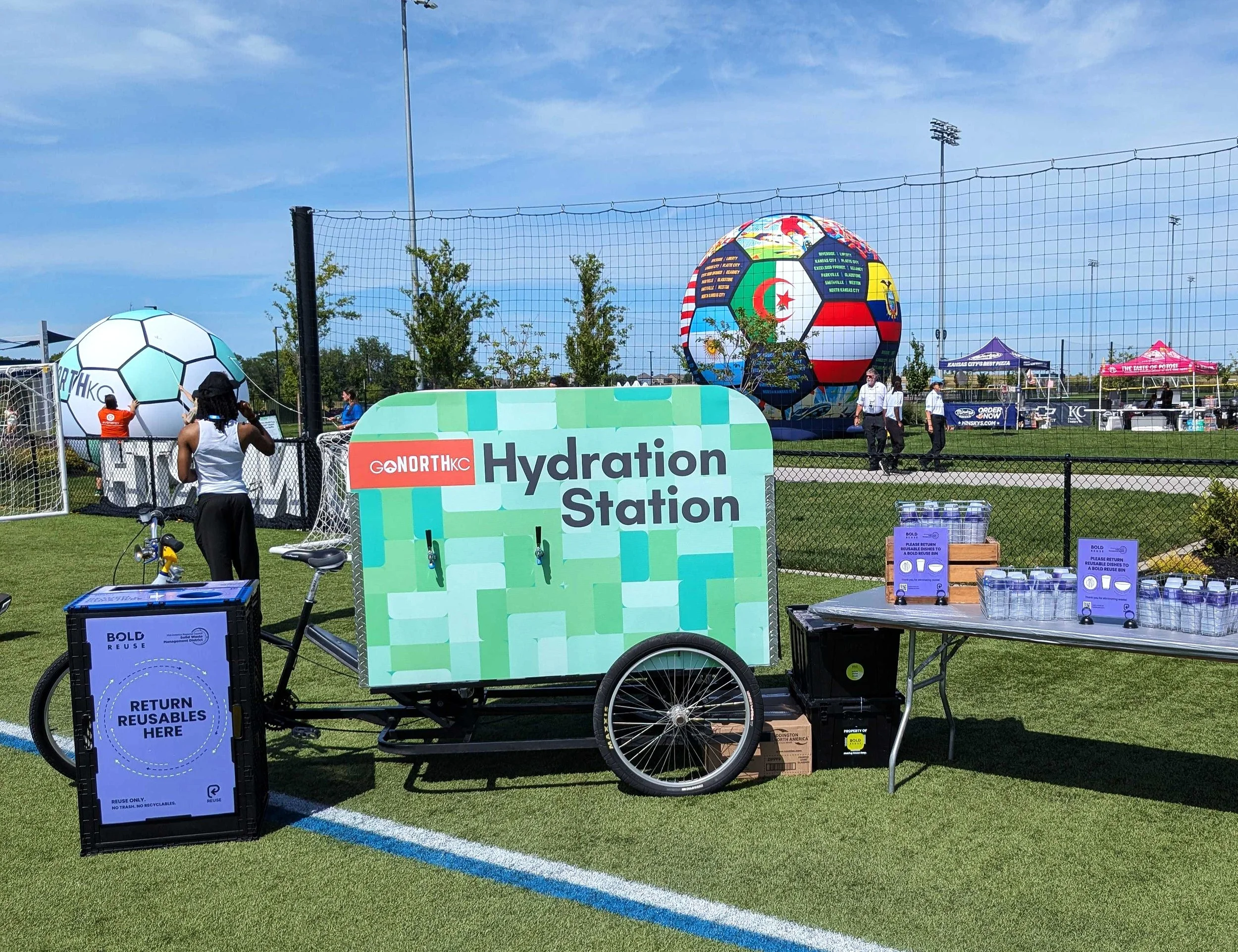
Bold Reuse at North Kansas City fan event (image: Bold Reuse)
A Better Design Opportunity
For the duration of the World Cup, host stadium operations were fully ceded to FIFA. In order to control branding and spotlight their sponsors, stadium names were shrouded and signage was covered. BC Place in Vancouver, which recently switched to 100% reusable cups, switched back to aluminum for the games.
Had FIFA operations managers implemented reuse, millions of cups could have been recirculated instead of subjected to a one-way fate (be that landfill, recycling, or even going home with fans as souvenirs). For the duration of 6-7 games, a tidal wave of reuse would have washed over the host cities… and then departed.
The games may have left a lasting legacy of reuse in their wake, but without local stakeholders involved — it’s just as likely they’d have left exhausted reuse service providers, shaky infrastructure, and decision-makers scratching their heads.
That’s because this siloed, top-down approach is antithetical to how a reuse economy runs. Even the robust, full-scale, interoperable reuse economy we envision is fundamentally local. Reusable materials circulate for years within a regional network of washing, logistics, collection, and return infrastructure. Materials stay local. Money stays local. Spending that used to leave the community in procurement and disposal costs stays inside it and compounds — in wages, in facilities, in local contracts.
Every environmental, economic, and social benefit that a reuse economy provides flows from this shift: from an extraction-and-disposal supply chain that runs one way, to a circulating system that a community can own. That’s not how the World Cup games operated.
But it is how the Fan Fests and watch parties worked. In Miami, a primary events concessionaire and their bartending staff now know how a reuse system operates. Diageo is bought in and would do it again. In Seattle, seven new water refill stations were installed around the city, intended to help the influx of tourists stay hydrated but now there as permanent infrastructure.
In Toronto, local councilors who have been hedging on the city’s single-use waste reduction ordinance saw reuse in action and at scale. As Muuse’s Morrison points out, “Our goal isn’t simply to replace disposable packaging. It's to build infrastructure that makes reuse the default option for live events.”
Seeds have been planted among those invested in their local communities, and that is how lasting change happens. What’s more, the majority of these events were free, which made them more accessible to the local community. When more residents are able to take part in local events that involve reuse systems, reuse becomes a normalized part of life in that city — leading people to think, as Seattle’s Sukhdev puts it, “Oh, that’s just how we do things here.”
So How’d They Do It?
Because reuse is a system that involves multiple players, it can’t happen in a silo. The World Cup got people talking and motivated action.
As with every reuse project and pilot everywhere, the keys to activating reuse in World Cup host cities were collaboration and stakeholder engagement. City officials worked with LOCs, who worked with event producers, who worked with concessionaires and reuse service providers. For unofficial events, reuse advocates worked with local businesses and neighborhood committees. (The other key to reuse is, of course, funding. Hosting the World Cup opened up funding in these municipalities from the LOCs and in some cases from local municipal sustainability funds.)
All those conversations that reuse advocates were having while they were “hurrying up and waiting” to see what shape World Cup events were taking in their cities? They paid off. As the landscape became more clear, and time ran short, they were able to leverage their pre-existing relationships to activate reuse on a short timeline.
Even in Miami, where there have been fewer conversations around reuse and no local precedent to follow, they were able to hustle into action. The County, as the reporting entity to FIFA, was interested in seeing reuse piloted. Diageo had already started talks with r.World about reuse. Belzaguy Hunter was eager to push for it. And r.World was ready and willing to work out dishwashing despite the lack of wash hub in Miami. This group effort toward a common goal is, Belzaguy Hunter points out, how a nascent reuse industry will scale:
“Collaborators being engaged and the washing solution being a thing are the two pieces that were absolutely necessary, but if I had to prioritize one of those, it would be the collaborators… Because we didn’t have the washing figured out at first, and we made it happen because we were all so committed to seeing it happen. And I would dare to say that even if we hadn’t figured out this local washing solution, that the County or one of our other stakeholders might have still wanted this so much that we would have figured something else out.”
Even the conversations that did not lead to reuse being implemented specifically for the World Cup matter tremendously. They have what TEA’s Emily Alfred calls “conceptual impact.”
Advocates vying for reuse in their host cities engaged with event organizers, concessioners, government representatives, and other stakeholders who may not have been as ready to listen before such a high profile event injected some energy into the conversation.
“We’ve been talking about reuse and single-use regulations in Toronto for a number of years, and I think people were getting bored of hearing from me,” Alfred says. “But then I started talking about FIFA and… there were different elected officials to talk to because those who were interested in soccer now wanted to talk, not just the ones on the environment committee. So it opened doors and also opened people’s minds to think, ‘Okay, what can we do that’s different? How can we stand out?’”
Lingering Barriers
Host cities that featured reuse in one way or another have all taken steps forward in normalizing or scaling reuse systems. What’s next for these cities, and others like them that have activated reuse at events and beyond? And what continues to stand in their way?
Beyond the deliberate perseverance required to convince stakeholders, FIFA and the surrounding fan events brought to light some of the more persistent issues that crop up when trying to transition sports and entertainment venues to reuse.
Bottled Beverages
Some reuse service providers and event producers reported they could have made deeper inroads at the Fan Fests they served had more fountain drinks been on offer. Even in venues that do feature reuse, bottled and canned beverages are still pretty ubiquitous. Many venues prefer bottled beverages at high-volume events because they make for faster turnaround in comparison to fountain drinks. Moreover, following the COVID shutdowns, a lot of venues switched over to bottles because of the perception that they were the more “sanitary” option. And, some soft drink contracts offer fountain beverages while others offer bottled. So whether a venue can offer fountain drinks with reusable cups often comes down to who they contract with.
Aluminum “Souvenir” Cups
The FIFA World Cup games themselves focused on serving beverages (at a premium) in branded aluminum “souvenir cups” featuring the team names for that day’s match. These cups were touted as sustainable because they were meant to be brought home as a keepsake and/or recycled. Aluminum may be infinitely recyclable, but aluminum recycling does not keep up with our demand for the material — and more demand means more destructive, energy-intensive bauxite mining and processing (the impacts of which are massive).
What’s more, these souvenir cups were designed to capture a moment in time. Excess stock is inevitably waste — it can’t be reappropriated to another event. Some fans will toss the cups immediately, and some will bring them home and dispose of them at some point down the road. And unlike the Miami and LA Fan Fest cups, the aluminum souvenir cups can’t actually be reused as drinking vessels: the plastic lining inside and out can’t survive a hot wash. Whether or not they are touted as a souvenir, aluminum cups aren’t just a FIFA thing. They are becoming more and more common at sports and entertainment venues.
Regardless of the material, fan beware: souvenir cups that are intended to be brought home are increasingly marketed as “reusable.” While it may be true in the literal sense, a cup that can be reused is not the same as a reusable cup that is part of a system of reuse — a system that drastically lowers the environmental, social, and economic impact of a venue’s foodservice. A cup that goes home with the fan serves an expensive, resource-intensive one-way function.
“Whether it’s a plastic soft drink bottle or a lined aluminum cup, anything designed to be used once and tossed (now or years from now) reinforces a broken take-make-waste system. ”
Both of these barriers point to the same core issue: whether it’s a plastic soft drink bottle or a lined aluminum cup, anything designed to be used once and tossed (now or years from now) reinforces a broken take-make-waste system that doesn’t truly serve fans, concessioners, or venue operators. Reuse systems operating at the scale of major events have the potential to normalize a far more economically and environmentally sustainable practice for millions of fans and take the strain off overburdened, and oversubsidized, recycling and waste management systems.
Looking Ahead
What’s next for reuse? Clearly, lots of sparks have been set off in host cities around the US and Canada. Hopefully they will initiate more long term, scaled reuse projects in these same cities. The momentum, and the business case, is there.
In the meantime, next on the horizon for major international sporting events is, of course, the 2028 Olympics and Paralympics in Los Angeles — organized by the official LA28 committee.
In recent years, Olympics host cities have been keeping a keener eye on the impacts of new infrastructure they create for the Games, learning from past Olympics that have left excess, expensive, and under- or unused infrastructure in their wake. But we are hopeful that LA28 stakeholders see reuse systems as necessary infrastructure that the City can leverage for years to come. LA28 may be a one-off event, but with proper planning, it can have a localized and lasting positive impact.
Luckily, those conversations have already begun (as well as for the 2032 Olympics in Brisbane, Australia). LA28 has set sustainability commitments, including “radical reuse” — an umbrella term that comprises circular economy principles more broadly, but indicates an opportunity (and signals interest) in reusable foodware specifically as well.
With reuse momentum already strong in LA, and single-use plastic reduction top of mind with the rollout of California’s SB 54, all of the pieces and players are in place to put reuse center stage at the world’s next big sporting event. When commitment at the top meets local upswell, we know the impact can be transformative.
Curious to learn more? Check out our accompanying episode of The Indisposable Podcast: Scoring Goals for Reuse