
Why sports & entertainment venues are ripe for reuse
It’s Super Bowl season, and while fans are thinking about touchdowns, fumbles, and Bad Bunny’s half-time show, at Upstream we’re thinking about reusable cups. Assuming a sold-out event, 75,000 spectators will be flocking to Levi’s Stadium and ordering an estimated 22,500 fountain drinks on Super Bowl Sunday.
This astounding volume is why the sports and entertainment sector — serviced by large venues and arenas — is not only ripe for reuse, but uniquely positioned to help scale reuse systems. In fact, the Super Bowl will feature reusable cups this year in select sections of the stadium, building on a pilot program Bold Reuse and PepsiCo launched with the San Francisco 49ers for the 2025–2026 NFL season.
“Reuse is, in my opinion, one of the most exciting and most dynamic spaces within sustainability in sports and entertainment today.”
Most importantly, though, stadiums and event venues adopting reuse accelerates the buildout of reuse infrastructure like wash facilities and collection and transport equipment. With a contract or even a letter of intent from a major venue, reuse service providers can secure the financing needed to build out washing facilities and purchase necessary equipment.
Reuse Service Provider: a company that provides the infrastructure, logistics, technology, and/or staff that enable collection, washing and sanitation, processing, and recirculation of durable, returnable products and packaging.
Once that infrastructure exists because of a stadium's commitment, the entire community benefits. Grocery stores and school systems that couldn't afford reuse systems on their own can now access services. Restaurants, local food producers, and even consumer packaged goods producers, can shift away from single-use packaging. The economy of scale established by the stadium or arena creates accessibility for the entire metro area. What begins as a sustainability initiative for a sports venue becomes a transformation in how an entire city thinks about waste and materials.
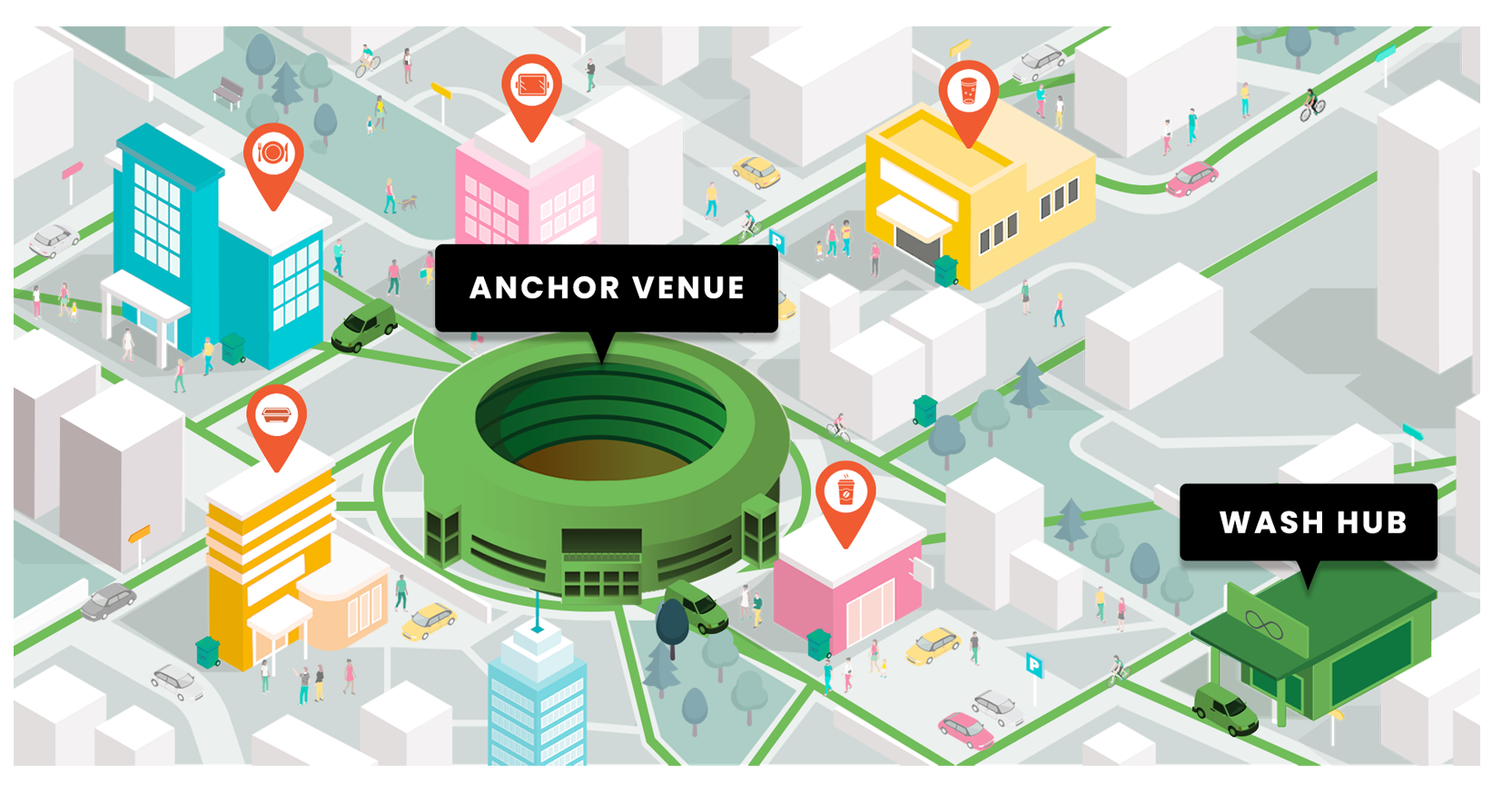
Large volume anchor venues create demand at scale to justify the investment and buildout of wash, sort, and redistribution hubs.
Big Wins: High Impact, High Visibility, High Return Rates
These large venues have a lot to gain by switching to reuse, and so do the rest of us. A single regular season NFL game generates over 80,000 pounds of waste per stadium on average, totaling more than 44 million pounds per season. Almost all of this comes from food and beverage containers and food scraps.
The NFL, MLB, and plenty of other sports and entertainment organizations are well aware of the associated environmental, economic, and labor costs of all this trash, and have formed programs and nonprofits like NFL Green, Players for the Planet, and the Green Sports Alliance to address the issue. While many of their initiatives focus on composting and recycling, reuse sets the gold standard for meaningful systems change. According to Upstream’s Reuse Wins at Events report, the average stadium that hosts 100 events annually uses over half a million single-use cups — creating a whopping 6.34 tons of plastic waste. If these were replaced with durable, reusable polypropylene cups used 25 times each, that would generate a mere 1.11 tons of waste, an 83% reduction.
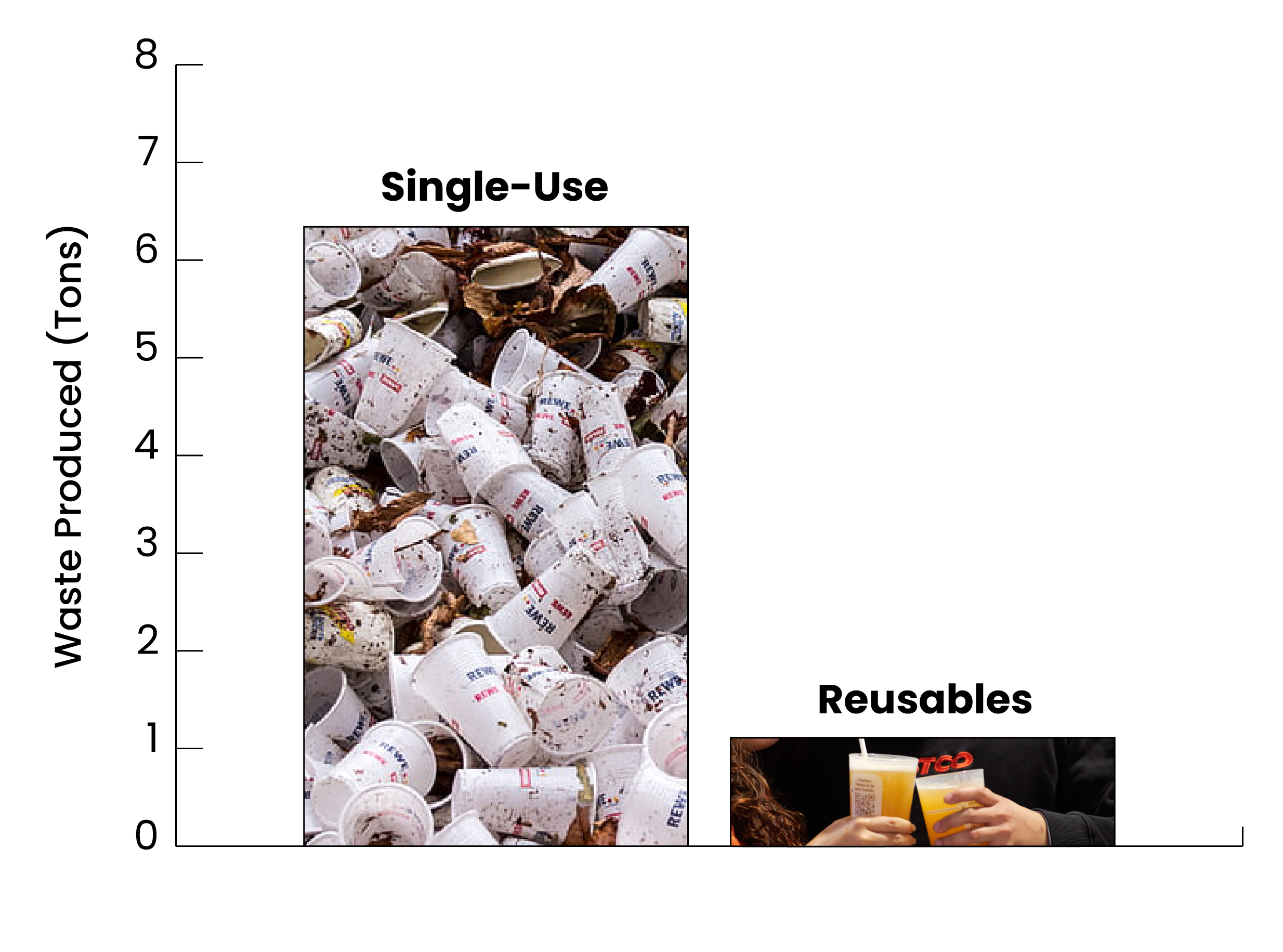
The average stadium that hosts 100 events annually uses over half a million single-use cups — creating a whopping 6.34 tons of plastic waste. If these were replaced with durable, reusable polypropylene cups used 25 times each, that would generate a mere 1.11 tons of waste, an 83% reduction.
Reuse service providers are well-versed in setting up clear, easy-to-adopt systems to ensure ease of use by consumers and vendors alike. And that’s critical because in order for reuse to take off, it must be as convenient for the consumer as throwing out their trash. In a closed-loop setting like a stadium, where disposal stations can be clearly marked, dropping an empty cup in a return bin creates little friction.
Every year, millions of fans from all walks of life pass through these venues. The more people interact with reuse systems in a controlled setting, the more natural reuse will feel in a larger interoperable system as it scales and spreads. There's simply no better platform to normalize reuse as part of our everyday experience.
Stadiums are also a sure-bet starting point for scaling reuse because serviceware items rarely leave the venue. Return rates for reusable containers in these closed-loop settings often exceed 90% — far higher than any other setting. This is where the real environmental benefits and ROI of reuse are realized. The longer a cup is kept in circulation, fewer resources are required to produce replacement cups, and fewer end up as trash. And while they cost more than single-use up front, reusable cups that effectively recirculate ultimately cost less than the procurement and waste hauling costs associated with single-use products.
Reuse is Scoring Points
“Reuse is, in my opinion, one of the most exciting and most dynamic spaces within sustainability in sports and entertainment today,” claimed Mary McCarthy, VP of Sustainability for Levy Restaurants, speaking on The Indisposable Podcast in 2025. Levy serves as the food and beverage concessionaire at Moda Center in Portland, OR as well as Levi’s Stadium in San Francisco — both of which have reuse systems run by reuse service provider Bold Reuse.
At this point, many stadiums have either run pilot reusable cup programs or provided reusables for certain beverages or at special club levels or hospitality suites, but an increasing number are coming fully on board. In just one example, Crypto.com Arena in Los Angeles switched to a full-on reuse system for beverages in October 2024. In the first six months, they achieved a 96% return rate while saving over one million cups from going to landfills and preventing 12 tons of trash. But perhaps most importantly, notes Head of Operations, Ignacio Guerra, “Guests are comfortable with the reuse… They want to be part of the solution. They know that we're doing the right things.”
These reuse systems also do the right thing for local economies. Rather than relying on long, volatile supply chains to procure single-use packaging, venues that forge an anchor contract with a reuse service provider help keep resources circulating locally while creating opportunities for more jobs. Discussing the buildout of a new washing facility in Denver, r.World’s Matthew Luisier provides an apt example:
We then needed someone to manage the wash hub. Then we needed a cup tech to inspect. Then we needed the people to deliver and pick up. Then we needed people to sort everything so it could go through the wash station. So we went from essentially zero to up to 15 jobs overnight just by building a wash hub. When you do that, it's important, because then you can bring on people who want to learn about reuse.
Beyond local economic and employment benefits, foodservice providers and their large venue partners would do well to get on board with reuse soon to keep up with global trends. A recent report by Future Market Insights forecasts that the closed-loop on-premise beverage packaging for hospitality and events market is expected to grow more than 250% over the next decade, from $560 million in 2026 to USD $1,420 million by 2036. This growth is expected to be exponential, as closed-loop systems are increasingly recognized for their ability to improve operational efficiency, reduce waste, and enhance the sustainability profile of hospitality businesses.
Come the Super Bowl, while fans are rooting for their favorite team, we will be rooting for reuse. Because when sports and entertainment venues adopt reuse systems, everyone wins.
According to calculations in Upstream’s Reuse Wins at Events report, an average of .3 cups/spectator are used per large venue event.