
Life Cycle Assessments in Reuse
LCAs: Why we need them, how to use them, and what to watch for
A life cycle assessment (sometimes referred to as a life cycle analysis) does just what its name suggests.
In essence, an LCA is a methodology for assessing the impacts associated with all stages of the life cycle of a product, system, or service. LCAs were not created for reuse systems, but they can be very useful when conducted well and interpreted correctly.
What’s a well conducted LCA, and how do you interpret one? Important questions for any reuse advocate to dig into!
What is an LCA, anyway — and why would I want to use one?
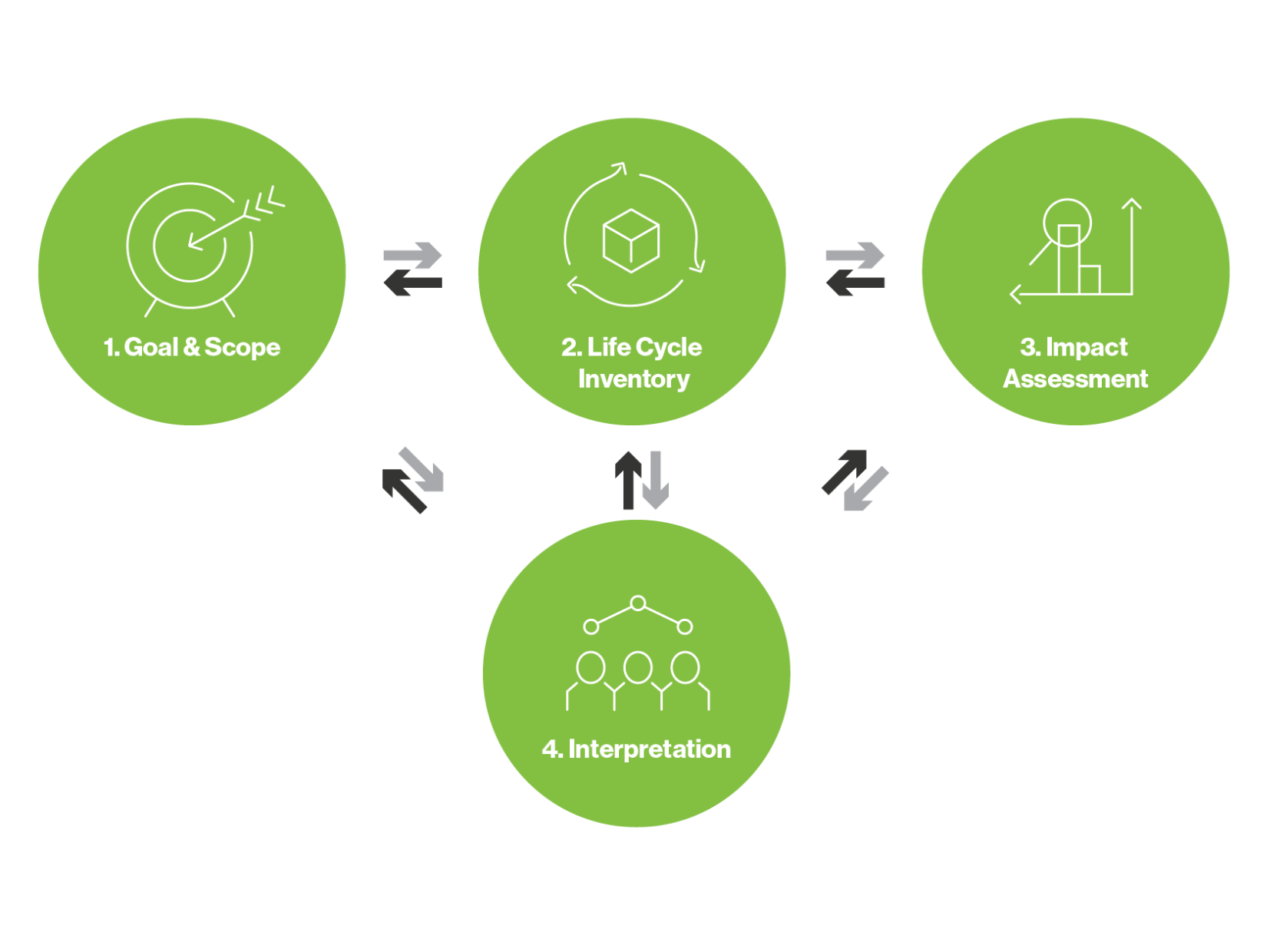
LCAs can help businesses, advocates, and policymakers make informed choices. Conducting an LCA involves four main parts: establishing the goal and scope of the LCA; compiling an inventory of relevant inputs and outputs; evaluating the potential environmental impacts associated with those inputs and releases; and interpreting the results to help stakeholders make a more informed decision.
In the reuse space in particular, LCAs are often used to compare alternatives — for example, comparing a single-use disposable cup to a reusable cup.
LCAs can also be used to identify impact hotspots. For example, a reuse service provider with an existing reuse system in place may want to know which stage of their container’s lifecycle has the largest impact, in order to improve the system. Impact hotspots will point out those weaknesses.
Reuse LCAs are also helping to build a collective evidence base for the movement. Contributing to more LCAs and deeper LCA science is a critical part of accelerating the reuse sector.
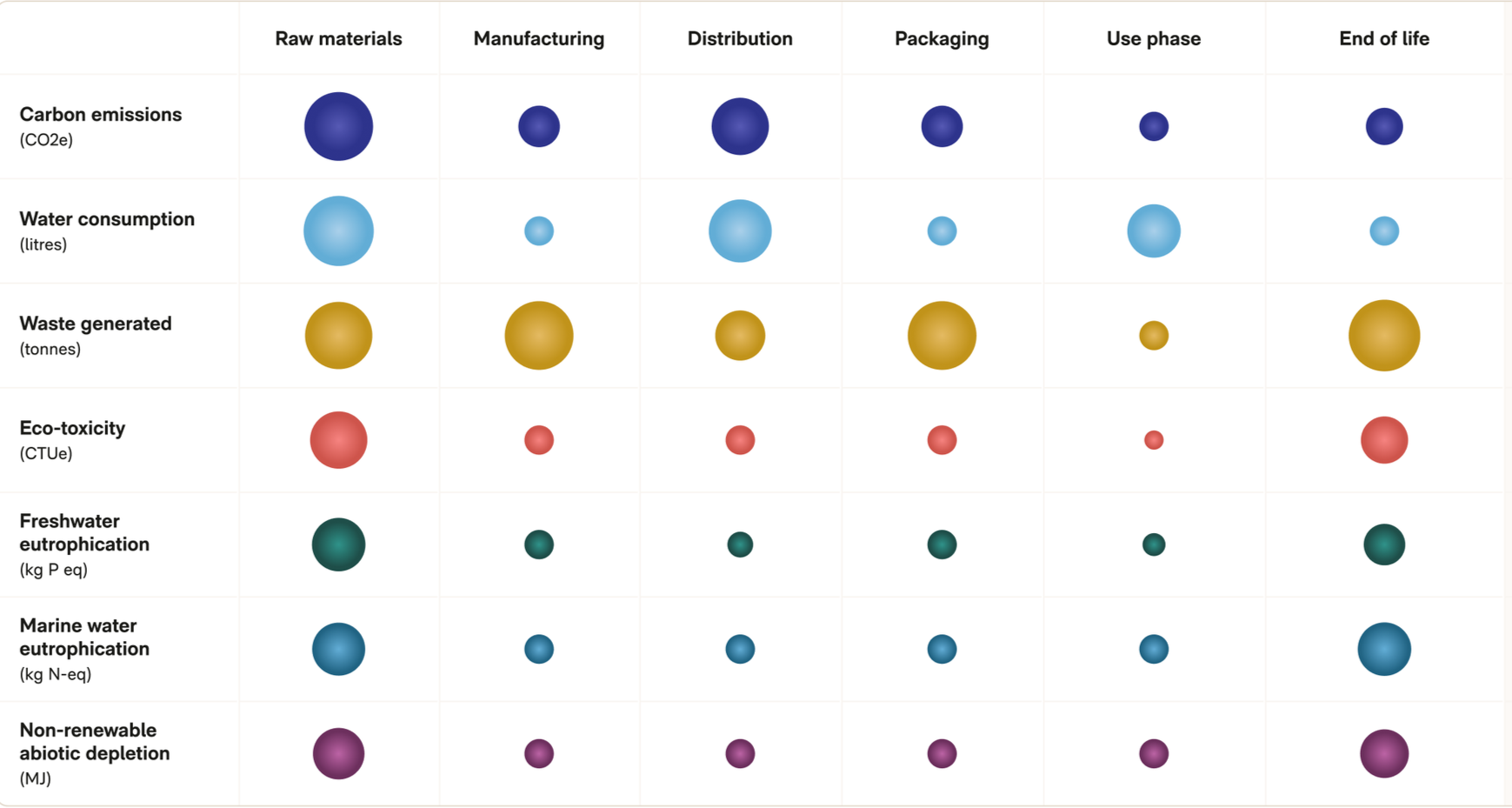
Identifying Impact Hotspots
source: www.vaayu.tech
Where do LCAs exist in the reuse landscape?
A variety of entities and organizations across the reuse sector conduct and publish LCAs. Knowing who is behind the commissioning of an LCA is an important step in understanding the motivations for each study.
This information may not be directly available within the LCA, but if you're looking to source and reference data for and from an LCA, then you'll want to know who's paying for it, who's carrying out the LCA, and what sorts of interests they have in doing so.
For instance, a big brand may want either the single-use or reuse scenario to yield more favorable results in a comparison, depending on their commitments and interests. And a reuse advocate will have different intentions in using LCA data than policy and government folks. A policymaker, for instance, may be looking at certain thresholds relative to a particular law or regulation, while an advocate needs to show how reuse outperforms alternatives to achieve stakeholder buy-in.
Sectors using LCAs in their work
LCAs are not perfect. They weren’t developed specifically to analyze reusable materials.
It’s important to acknowledge the sensitivities and limitations to LCAs so that we can take a clear-eyed approach to leveraging the useful data that an LCA does provide.
The biggest sensitivity is that important social equity, local, and system-level impacts can extend beyond what an LCA is designed to measure. Certain quantitative and qualitative impacts that aren’t meant to be included in an LCA may still be critically important to improving a system or informing a decision. A new wash hub may check all the boxes for environmental metrics, for instance, but be sited in an area without community buy-in.
LCAs also pose an accessibility issue: conducting an LCA requires money and resources that many organizations do not have. Inversely, many of the most highly visible LCAs are conducted by organizations that do have money and resources — and as noted, it’s important to consider the motivations of these more resourced organizations. Inherent biases become baked into the data pool based on who is able to publish the science.
What’s more, reuse-specific LCA research remains limited, and relatively few reuse LCAs have been conducted so far. Part of the reason for this is that conventional LCA approaches can struggle to represent complex, dynamic circular systems — particularly those, like reuse, that rely on human behavior.
One LCA on one reuse system, therefore, does not and cannot tell a larger story about reuse. Analysis of one 16 oz polypropylene cup in a reuse system for a sports venue, for instance, cannot tell you how all reusable cups perform in all sports venues.
Why do we still need LCAs?

Despite their shortcomings, we still do need LCAs. They are an established tool that has been around for half a century. They are trusted and widely referenced both within and outside of the scientific community, and it's unlikely that their role in environmental analysis is going away.
More critically, reuse as an industry needs competitive evidence. Reuse is at a pivotal point wherein the industry is directly competing with alternative industries like recycling and composting for contracts and funding. And in the policy world, packaging EPR is continually gaining momentum, creating more pathways for scaled reuse.
The recycling industry has decades upon decades of research it can reference to argue its case to decision-makers. While reuse systems have been gaining large-scale, highly visible contracts like the Super Bowl and festivals like Tomorrowland, implementation is arguably outpacing science — and reuse science needs to catch up.
What makes LCAs for reuse different?
The life cycle phases of single-use and reusable items run parallel… up to a point. But where a reusable item starts moving in a circle, a single-use item continues to run in a straight line. This divergence marks a significant difference in their impacts.
Consider a disposable polystyrene clamshell compared to a polypropylene reusable clamshell. Both require raw material sourcing and acquisition of those materials. There are phases of transportation throughout production, manufacturing, and delivery — up until their point of use. These life cycle phases are relatively similar between the two products (the impacts may differ, but they are following parallel tracks).
Then comes the use phase. The use phase for a single-use clamshell is somewhat negligible: a consumer eats out of it for minutes and throws it away. A reuse system’s use phase, on the other hand, is where the bulk of the significant impacts come into play.
In a general reuse cycle, the reusable clamshell is distributed to the customer. It's used, returned to a return station, and then some form of transportation is involved in collecting, washing and sanitizing, and redistributing the reusable clamshell. Each of these steps is part of the “use” phase of the reusable container, and each contributes its own impacts. A blink in the life cycle of a single-use product is where a reusable product spends most of its life.
This does not, however, mean that a reusable item will compare unfavorably against a single-use item — and this is where assumptions come into play.

Key Reuse System Assumptions
The assumptions that are fed into an LCA have a significant impact on the outcome, so being exact about the assumptions is key to producing an accurate LCA.
-
The number of uses that a reusable item achieves in its lifespan is arguably the most important assumption in modeling reuse. Ideally, this is a real-world number from a reuse operator who tracks their reusable items and knows the average number of uses across their system’s containers. But much of the time, LCA scientists don’t have that number and need to make an assumption about the average number of uses.
Beware of merging the concepts of reusable item durability with the number of uses that are modeled in the system. While a durable material like stainless steel can withstand a high number of uses, it isn’t generally reasonable to assume it actually attains as many uses as it can withstand.
Most of the time, the determining factor for the number of uses in a system is the return rate — the percentage of reusable items that are returned to the system to be washed and reused. A return rate decreases when customers take the reusable containers home or accidentally throw them away — common and expected behaviors, particularly in a new reuse system.
Red flag warning: watch for LCAs that assume unreasonably high or low return rates or number of uses. For instance, some big brands have published LCAs that assume a low 50% return rate, an average of only two uses, when modeling a hypothetical scenario — which does a disservice to the reuse industry by not reflecting best practices.
-
Within the use phase — which for a reusable is its cycle through the reuse system — transportation normally takes up a fairly small slice of the pie. If you see that transportation is making up the bulk of impacts in a reuse LCA, that’s another red flag. Check out the assumptions and see if they look reasonable or operationally efficient.
For example, if an LCA assumes a consumer is driving to a fast food restaurant, getting their meal in a 32 ounce reusable clamshell, driving back home, then making a dedicated trip to drop off their reusable container at a return station and driving right back home (instead of returning the container as part of another multi-purpose trip) — then the results of the single-use versus reuse system comparison will be skewed.
It’s important to scrutinize assumptions like this: if they don’t reflect the behavior patterns you’d follow in engaging with a reuse system, chances are they’re off-base.
-
Depending on the assumptions and on the reuse system, dishwashing can account for significant impacts when it comes to the use phase (but it doesn’t have to).
Look out for the type of dish machine being used in the model and its efficiencies. Large scale reuse systems use highly efficient, high hourly throughput dish machines that optimize the amount of water and electricity that they use per cycle. Smaller reuse systems may actually use less efficient washing, so there can be a nuanced inverse proportionality when it comes to the size of the system and the size of the dishwasher.
Where hand washing is assumed in an LCA, it’s usually applied to a personal travel mug that’s washed at home. Hand washing uses significantly more water than a dish machine and should not be applied to a reuse system at scale.
-
Anyone who has had a touch point with designing or operating a return system knows how much precision and detail goes into optimizing the system — environmentally, operationally, and also to make the economics work.
Watch, therefore, for assumptions that seem misaligned with operational best practices — for instance, fitting two boxes of reusable clamshells into a truck for transport, when that number is more likely to be 200.
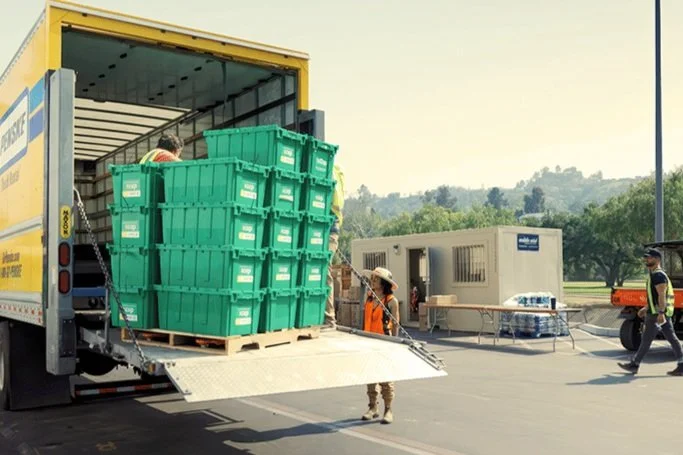
image: r.World
How are LCAs built?
LCAs are built to align with ISO standards — neutral, third-party methodological frameworks that essentially lay the ground rules for LCAs. They follow a step-wise process from defining the goal and scope, completing a life cycle inventory, creating an impact assessment, to interpreting results.
-
The goal states the intent of the LCA — e.g., comparing a disposable polystyrene clamshell to a reusable polypropylene clamshell.
Defining the goal and scope also involves defining the “functional unit” — or, what is being assessed. The functional unit provides the basis for measuring impacts, so in the final calculations, impact is enumerated per functional unit.
In an LCA comparing hand-drying with paper towels versus hand-drying with an electric hand dryer, for instance, the thing you’re ultimately comparing is one pair of dried hands — that's the functional unit.
You can think about comparative reuse LCAs in the same way. Sometimes, you may see LCAs that directly compare production of a single-use polystyrene clamshell to production of a polypropylene clamshell — strictly looking at product life cycles but not the systems in which they operate. Static product comparisons are not an accurate representation of holistic impact.
A more accurate way of making this comparison would be to consider the “service provided” by the clamshell — e.g., one use of the item. Because it is inherently single-use, one use of a single-use polystyrene clamshell is the same thing as one polystyrene clamshell. One use of a polypropylene clamshell (which, remember, gets many, many uses) provides an accurate snapshot to compare to the polystyrene clamshell because it captures the fact that upstream impacts decrease the more times it’s reused.
Next up: establishing system boundaries, or deciding what should be left out of consideration for the LCA. LCAs are finite by nature, so for the sake of the study, it’s necessary to draw a line around which externalities to consider and how much detail to go into. These boundaries may be determined by how much system detail is available. For a comparative LCA, it’s important to draw parallel boundaries around both the reuse system and the single-use system.
-
A life cycle inventory involves collecting and quantifying all material, energy, and resource inputs and environmental emissions or waste outputs for a product system across its entire lifespan. In the reusable clamshell scenario, for instance, an input could be the energy required to run a dish machine cycle (just one cycle, because the functional unit is per use of the reusable clamshell).
These data points often come from an LCI database such as EcoInvent. These databases are good places to source numbers around unseen upstream processes, like what's involved in the production of a certain material. The most accurate results, of course, will come from actuals from the system being analyzed. A reuse system operator, for instance, likely knows — based on utility bills — exactly how much electricity is required to run their dish machine.
The LCI stage is also when any key assumptions are quantified. Looking back to the dishwashing of that reusable clamshell: a reuse operator may know exactly how many kilowatt hours are required for one cycle. But maybe clamshells are a new product and they don’t know how many fit on a standard dishwashing tray. So, they make an assumption. An outlier assumption, like two reusable clamshells can fit on a tray, would significantly increase the impacts of that use phase. Field research interviews with reuse system operators may lead to a more realistic assumption, and therefore a much lesser impact assigned to each reuse. Every assumption at each point in the use phase can change the final results.
When citing an LCA, it’s important to look at the system boundaries, read through the assumptions, and gut-check them against the inputs and outputs. If something looks off, most LCAs will have a limitation section where they acknowledge a lack of confidence in a certain data point or a data gap that they were unable to fill. A limitation does not mean an LCA is “bad” — especially if it is transparent about those gaps — it just indicates a grain of salt that may need to be added to the conclusions.
-
The life cycle impact assessment (LCIA) outlines the results of the LCA to determine the system’s environmental impact. Specialized software converts the numbers from the LCI — like kilowatt hours for running a dishwasher — into an environmental impact.
Certain regions and sectors have requirements around which environmental impact categories to use in an LCA. But it's also common for the people conducting the LCA to choose what they want to show at this stage — another important point at which to scrutinize who is conducting the LCA and what their motivations may be.
Given the intermediate calculations and assumptions that go into producing them, these environmental impact numbers are inherently imperfect, but meant as a way for people to digest the information that comes from an LCA. The fact that these numbers are imperfect can have greater implications depending on the category — for instance, human toxicity. Depending on how much research went into the study and how the results are communicated, the report may be harmfully misleading.
-
The interpretation — or conclusions and insights — stage of an LCA outlines its key findings. It should make clear that the LCA was conducted consistently across each step, so it's aligned with the goal, and that it stuck to the system boundaries and related back to the functional unit. The end of an LCA report should include all assumptions and limitations, and ideally, a raw data set for you to reference.
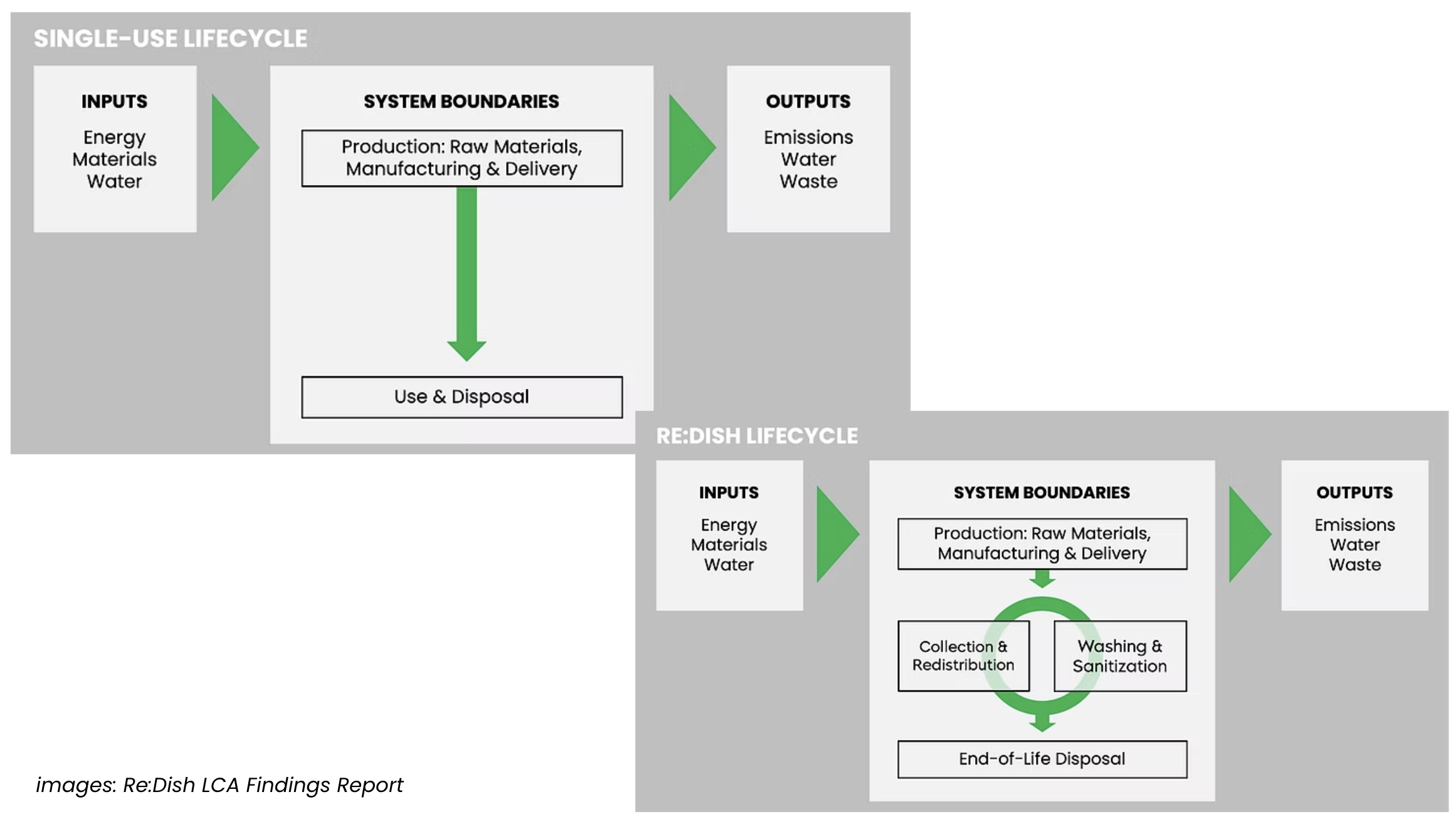
A life cycle inventory diagram example from Re:Dish
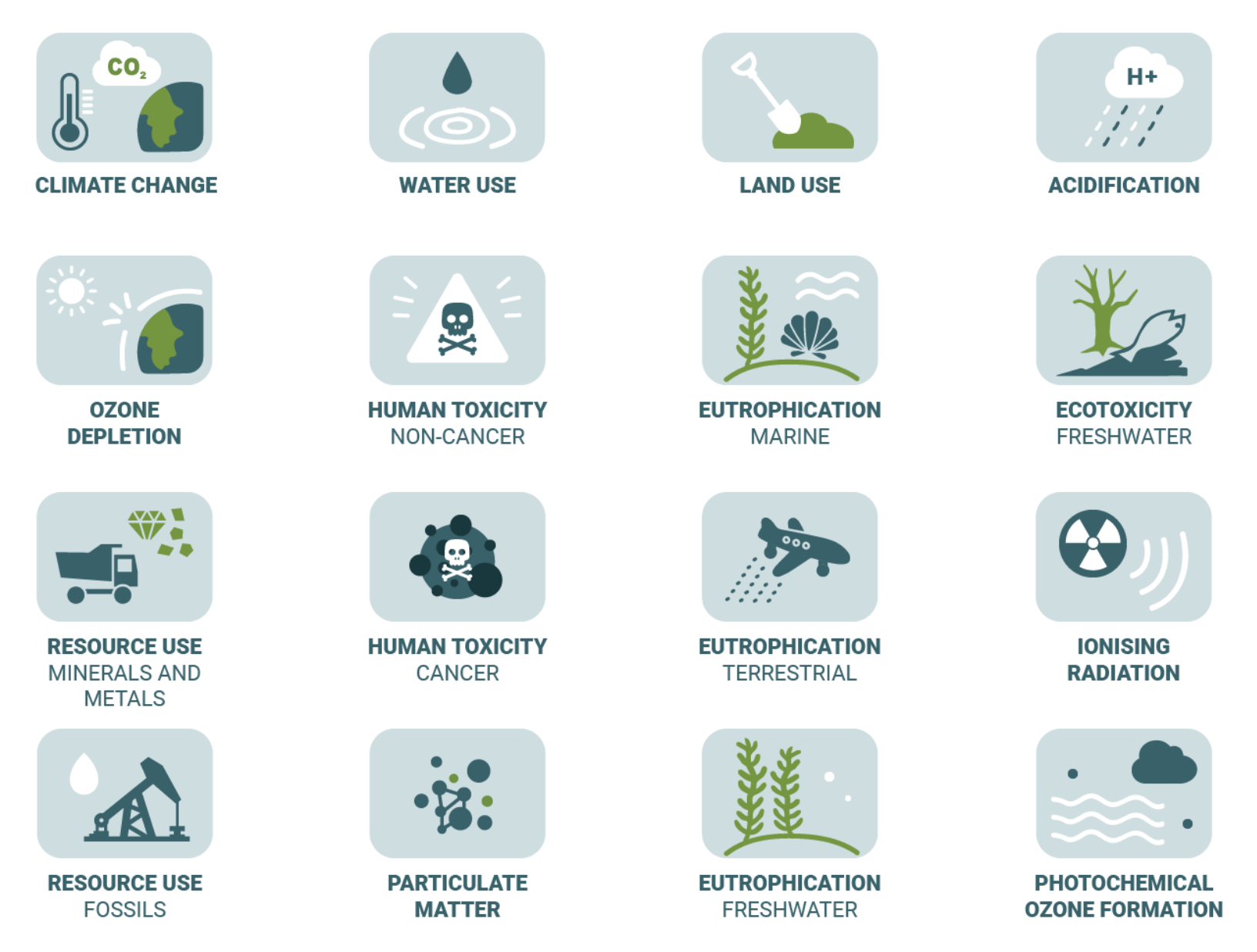
Environmental impact categories
What does reuse need from LCAs moving forward?
source: Design Boom / elium studios
As the reuse movement seeks to leverage LCAs to build a case for reuse, it’s important not to think of LCAs as “good” or “bad” science, or throw them away at one sign of a bad assumption. Instead, we need to be able to interpret LCAs critically and respond to questions stakeholders may ask about an LCA.
LCAs aren't and shouldn't be an all-encompassing tool. They are a singular quantitative tool for your tool belt of other resources that you can use to assess a reuse system. Always supplement LCAs with “lived,” or qualitative, evidence — the different human or environmental impacts that aren't and can't be captured within an LCA. That could look like a case study from a certain region near a manufacturing plant, or historical tracking of water pollution, or a community survey or interviews.
We must evolve methodologies specifically for reuse and standardize its data infrastructure. The global reuse standards organization PR3 is currently working to standardize LCA methodologies. Upstream has also developed Chart-Reuse®, a reuse analytics platform that uses LCA frameworks to focus in on the use phase, where all the action is in a reuse system.
The bottom line: In the context of reuse, the goal of LCAs and more so, broadcasting of their results, is about turning evidence into action. At the same time that implementation of reuse systems is moving rapidly, reuse LCAs need to drive further implementation. Data and action can create a positive feedback loop that results in scaled reuse infrastructure.
Resources
-
What Makes an Effective LCA for Reuse?
-

What Else Makes an Effective LCA for Reuse?
-
U.S. General Services Administration LCA Overview