
Bold Investment in Enduring Solutions: The Reuse Market Unlocked
Capitalizing an Emerging Asset Class
There’s a hidden cost — and a golden opportunity — wrapped around almost everything we consume, day in and day out, around the world.
Today, single-use packaging for food, beverages, and consumer packaged goods is so ubiquitous it’s easy to forget just how recent a phenomenon it is. But it was never an inevitability. It was a choice, embedded in decades of infrastructure investment, supply chain design, and market incentives. Building our modern systems around disposability made reuse feel like the exception rather than the rule.
But we can reverse this “packaging determinism.” The single-use system was designed. We can redesign for reuse — but only with capital from bold, forward-thinking investors.
The Biggest Headwind? Capital
The case for reuse is rock solid. Reuse service providers (RSPs) represent a rapidly growing — and maturing — industry. Pilot programs have succeeded at scale — from college campuses to music festivals to sports arenas. Consumers are demanding more sustainable options and an enhanced experience.
Regulatory pressure is increasing, as well. Extended Producer Responsibility (EPR) laws are creating mandated demand and unlocking public funding for reuse infrastructure, while municipalities are actively seeking reuse partners. Local reuse policies and grant programs are continually expanding.
What’s more, PR3 and its diverse panel of 80-plus leaders have nearly completed development of six global standards to guide and de-risk the reuse industry. The first three standards are already being deployed around the world.
Scaled reusable packaging systems supported by shared, interoperable infrastructure are not only feasible, they’re within our collective grasp.
What’s missing is not proof of concept. What’s missing is capital.
Reversing packaging determinism requires more than advocacy. It requires building the financial and institutional infrastructure of a new industry — the tracks on which a reuse economy can accelerate.
Reuse systems represent an emerging and promising asset class: logistics companies, tech platforms, and service providers rebuilding food service and packaging infrastructure for true circularity. They offer delivery, wash, and pick-up of reusable packaging at scale — servicing large venues and events, operating multiple wash facilities, and expanding rapidly in North America and internationally. But these reuse companies are growing without the capital that other industries take for granted.
An essential foundation of which many other startups build? Impact investors. The reuse industry needs investors who understand the sector and its vast potential, and are ready to take the leap to catalyze an enduring reuse economy.
Why Reuse is a Portfolio Imperative
Single-use packaging presents major portfolio risks not yet priced into markets: tariffs, rising material costs, supply chain vulnerabilities, regulatory uncertainty, and geopolitical instability. Even those not directly investing in packaging are most likely investing in some form of packaged goods — which are in turn subject to the same volatility.
Reuse addresses these portfolio risks while offering investable climate solutions. In a reuse system, companies purchase durable reusables up front and circulate them regionally or locally. The packaging, now a reusable asset rather than a single-use liability, retains its value. The supply chain shrinks dramatically. That's a fundamentally different economic model. Reuse localizes supply chains, insulates against commodity shocks, and hedges against the regulatory tightening already underway.
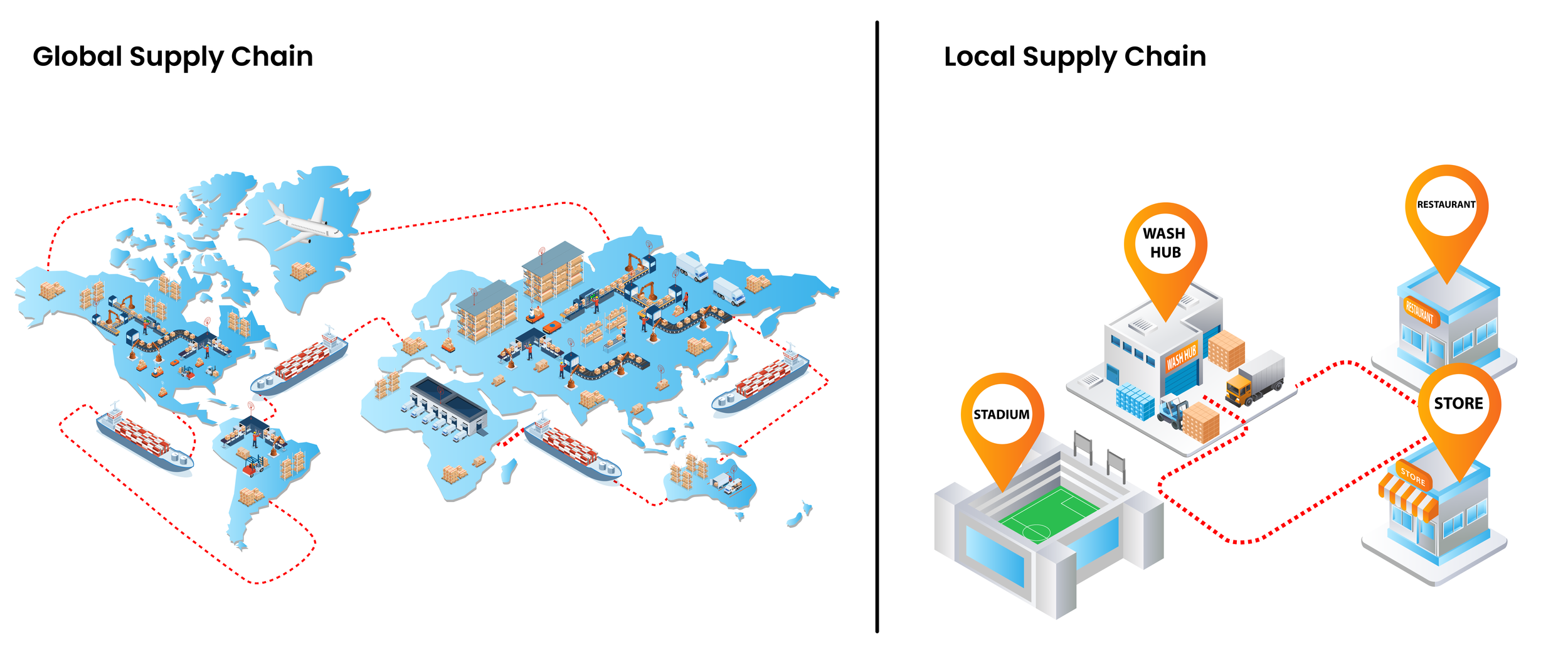
For venture, seed, and impact investors, reuse companies represent entry into a dynamic industry rebuilding packaging infrastructure for true circularity.
A Flywheel Effect
Take, for example, the sports and entertainment industry — a sector ripe for reuse. Catalytic capital in the amount of $40M to build scaled reuse infrastructure would allow for 36 major venues across 12 cities to shift to reuse. This buildout would lend exponential impact to the metro areas where it is sited, allowing schools, restaurants, and shops in the same neighborhood access to reuse services.
Over a three-year buildout — serving only venues, not (yet) the surrounding businesses — the impact would be profound.

These resource savings represent climate and community resilience solutions that are durable, scalable, and grounded in the real economy. They are solutions that don't just reduce harm but actively build something better — not least, safe, green, local jobs.
Sustainability Also Means a Stable Workforce
Reuse systems require people — to collect, clean, redistribute, maintain. This workforce drives an enduring reuse economy that continually pays back the community in both financial and environmental dividends. The question of who builds these reuse systems and who benefits from them is one of the most important design questions in front of us.
Impact investors who want to see a just transition to a more localized, resilient, and sustainable economy can help guide this direction. As Yinka Bode-George of Sustain Our Future Foundation points out, investing in reuse through a model that directs a portion of the funding to local communities where infrastructure is sited begins to shift the extractive dynamic that has powered the single-use economy:
“As we look toward how to actually deploy circular infrastructure in a manner that doesn’t harm communities, we have to leverage community governance structures. Bringing communities in through ownership models and partnership is the key way to do it…. We risk creating a circular version of that same extractive, linear economy if we’re not careful. And so the opportunity is to not recreate that dynamic, but to create a circular economy rooted in better power dynamics of cooperation and partnership care.”
A Message to Investors: Go Forth, Be Bold!
More and more, communities, investors, and corporations are starting to grapple with the reality that disposable supply chains carry hidden costs: commodity volatility, regulatory risk, geopolitical exposure. Reuse reduces all of that.
That doesn’t mean an investment in reuse is risk-free. The industry is still new, and every new industry experiences growing pains and adjustments. But at a recent event, Sally Liu, a reuse investor, encouraged funders to embrace the possibility — and necessity — of reuse. “In the reuse economy, there are so many different opportunities, and they all take a bit of risk,” she said. “There are a lot of different mechanisms by which we can try to de-risk the situation, but we all still need to be bold in that outlook and be willing to invest in a variety of mechanisms.”
We’ve seen before how that boldness can help scale ideas. Reuse may seem like a niche industry right now — but at one point, so did solar. What did it take for solar to go from an overlooked, underfunded idea to a dominant energy source?
The answer was a combination of policy, financing, standards, market demand, and infrastructure investment — all working together. Reuse needs the same, especially when it comes to unlocking capital.
Liu thinks investors should take the plunge, together. “I think it behooves us in this space to take that opportunity and move forward… There's a lot of different models. Some will fail, some will succeed. We’ll all keep learning… and in doing so, advance the field to make [reuse] mainstream.”
Financing innovation is one of the most critical levers for getting reuse systems up and running at scale, in turn laying the tracks for a new economy. Impact investors are key to capitalizing this emerging asset class. So, as Liu says, “go forth.”