By Leslie Vryenhoek, Communications Consultant, North America Waste Pickers Alliance
Part of Upstream’s series examining the principles of a just transition and how reuse is in conversation with every element.
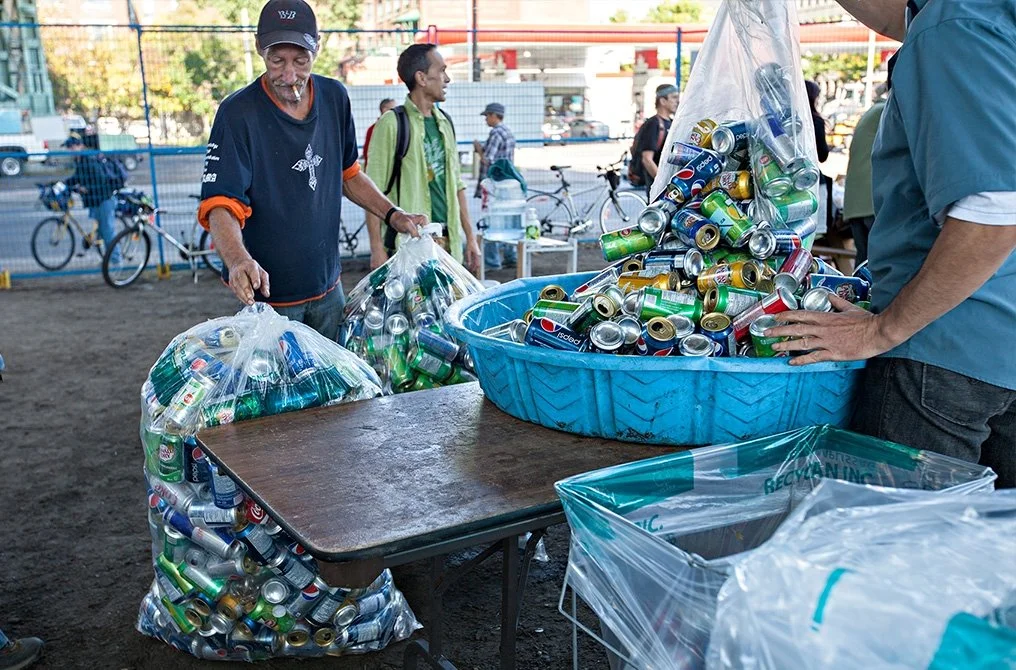
Valoristes redeem cans they have collected at the Cooperative les Valoristes in Montreal, Canada. Photo courtesy of CLV.
Across North America, an unrecognized labor force is cleaning up communities, reducing municipal costs, raising recycling rates — and has potential to raise return rates for reusables, too. They are waste pickers, the global term for those who collect and sort what others have tossed away. Like tens of millions of people around the world, this is how they earn income.
In Canada and the U.S., deposit-return systems (DRS) on beverage containers are the focus for most waste pickers.
It’s a simple enough concept: a person pays a deposit when they purchase a beverage and gets a refund for returning the empty container for recycling. Despite this incentive, many consumers don’t redeem their deposits. Some prefer to use curbside recycling; others can’t even bother to find a recycling bin, tossing cans and bottles into the trash or worse, along roadways and waterways, in parks and parking lots.
This is where waste pickers come in.
By collecting containers and taking them for redemption, they ensure more end up in the recycling system. And containers sorted and processed through a depot are more likely to actually get recycled than mixed waste from curbside bins.
A Lack of Recognition and Reward
Almost all Canadian provinces and 10 American states have some type of DRS, or “bottle bill,” on the books. Governments establish these systems to increase recycling rates and reduce litter in public spaces, where beverages are often consumed. These bills also divert material from expensive landfills.
While currently these systems primarily focus on recycling, they have potential to include reuse when, for example, refillable bottles are included.
DRS has another often overlooked benefit: it provides accessible income to people shut out of formal employment by age, disability, immigration status, language or some other barrier.
Whether they call themselves canners, binners, diverters, valoristes or something else, these prolific recyclers are essential to DRS success — yet bottle bills fail to recognize their contributions or open pathways to formal employment.
But three depots operated by and for waste pickers — one in New York City, one in Montréal, Québec, and one in Portland, Oregon — are paving the way to decent work by providing formal employment and advocating for the rights and value of waste pickers. Each faces challenges under its local DRS.
“Whether they call themselves canners, binners, diverters, valoristes or something else, these prolific recyclers are essential to DRS success — yet bottle bills fail to recognize their contributions or open pathways to formal employment.”
Sure We Can in New York City
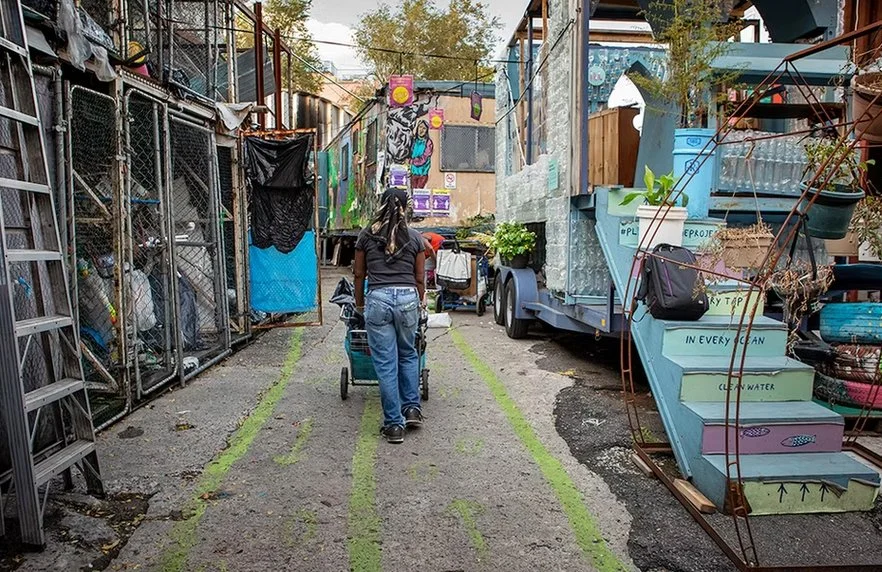
At the Sure We Can redemption center in New York City, communal gardens and art create a welcoming vibe. Photo by Carlos Rivera.
There are two sides to the DRS coin, both set by legislation. The first, obviously, is the amount of deposit and refund. The second is the compensation, usually a handling fee, that a center receives for accepting and processing containers. Because DRS is a form of Extended Producer Responsibility (EPR), this compensation is usually paid by the beverage industry.
Although just pennies per container, these two amounts have a huge influence on the local recycling industry. In New York, for example, a handling fee of 3.5 cents (USD) per container helped create a healthy network of recycling depots when it was established many years ago. Now, says Ryan Castalia, the handling fee is insufficient. As a result, many redemption centers have closed and others are struggling.
Castalia is the Executive Director at Sure We Can, a nonprofit recycling center in Brooklyn. Half of the center’s six employees, as well as the maintenance contractor, have experience as canners. Their firsthand knowledge of beverage containers is particularly essential in New York, where distributors are only responsible for taking back what they sell, so containers must be sorted by brand as well as by material.
More than a place to redeem recyclables, Sure We Can is a welcoming community space. A communal produce garden is nurtured by compost, rainwater and canners, while local art adds to the vibe. Occasionally, Castalia says, an artist offers a cash incentive for canners to collect a particular type of item. These externally driven initiatives are small scale, however, and only viable because they generate income.
“Recycling depots are a natural origin point for sustainable practices,” Castalia says, “but mostly, canners need to make money.”
For the estimated 10,000 canners in New York City, that isn’t easy. Sure We Can’s 2023 research found canners earn, on average, just $5.08 an hour while working 23.4 hours each week. The minimum wage in the city is $17/hour.
In New York, the 5-cent deposit-refund hasn’t risen in four decades, despite concerted advocacy. An improved bottle bill, which would raise the amount to 10 cents, has been proposed (again) but has not passed the state legislature.
Advocates believe the 10-cent refund would drive the recycling rate for beverage containers above 70% in New York. It’s worked in other jurisdictions. When Connecticut doubled its deposit-refund to 10 cents in 2024, its redemption rate on beverage containers jumped from 44% to 65% in a single year. Canadian provinces with 10-cent or higher amounts regularly see rates over 90%.
But to Castalia, the issue with low payouts is much bigger than recycling rates. “Both the material collected and the work of collecting and responsibly handling it are valuable. That should be recognized,” he asserts.
“Both the material collected and the work of collecting and responsibly handling it are valuable. That should be recognized.”
Coopérative les Valoristes in Montréal, Québec
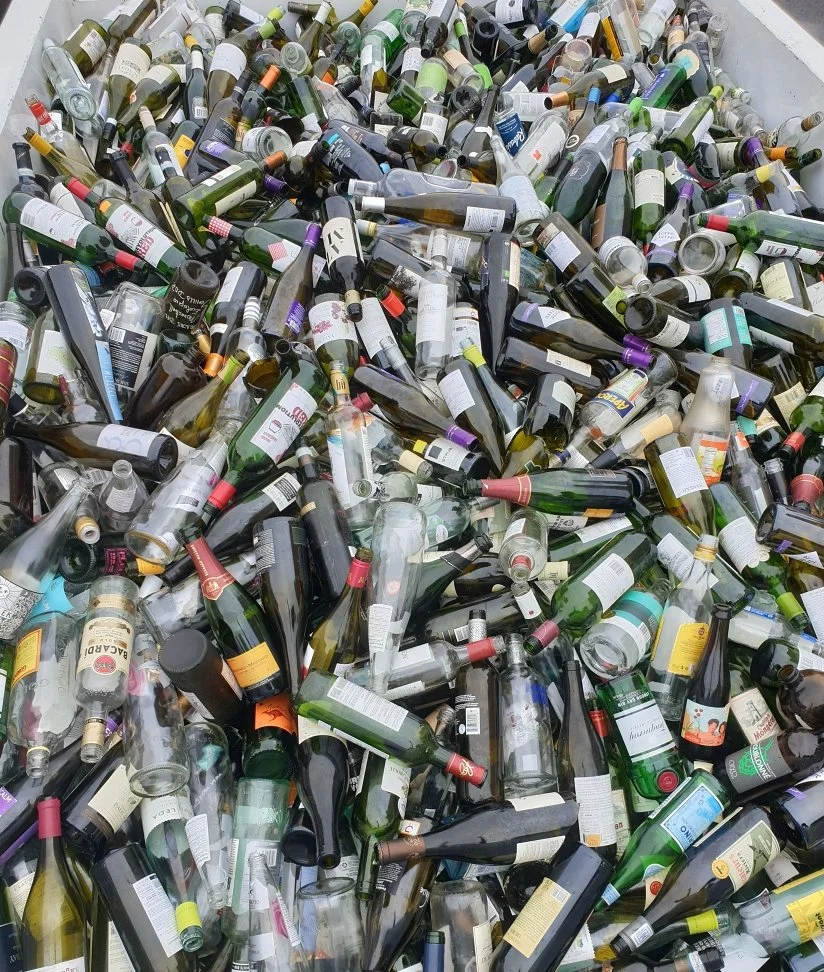
Cooperative les Valoristes accepts refillable wine bottles as part of a partnership with an external funder. Photo courtesy of CLV.
In Montréal, Québec, the handling fee of 2.5 cents (CAD) per container may be low, but receiving it has been a huge boost to the Coopérative les Valoristes (CLV). That’s according to CLV co-director Marica Vazquez Tagliero, who lobbied the province for a decade — with help from colleagues and significant media pressure — before the cooperative was granted the same handling fee that retailers receive for doing the same work. Prior to the change in 2025, CLV received nothing under the system, relying instead on community grants, donor funding and tons of volunteer hours.
Now, it can open for more hours, process a greater volume of recyclables, and, most significantly, provide decent employment for five people, including four valoristes. But it still struggles, surviving because it operates rent-free in a city-owned building — for now. The building has been sold and next year, CLV will need a new home in downtown Montréal, where the cooperative’s 161 waste picker members collect recyclables.
“The handling fee has to take into account the amount of work and things like the cost of the location,” Tagliero explains, “so 2.5 cents is not enough. We constantly have to seek other funds and partnerships.”
One external partnership recently led to the development of the Dignity Bag, a customized heavy-duty backpack that makes collecting easier and, because it is emblazoned with Montréal Équipe de Recyclage Urbain (Montréal Urban Recycling Crew), more visible.
Québec’s DRS currently has a 10-cent deposit-refund for plastic, aluminum and some glass beverage containers. But Québec is modernizing its DRS, and next year will expand to include all glass and tetra packs. (CLV accepts all glass beverage bottles now, as part of a partnership with an external funder.) The expansion to more types of containers will give valoristes more potential income.
Other changes, however, threaten CLV’s mission to provide decent work. Tagliero says the province’s new models for social enterprises aren’t designed with waste pickers in mind. “They want us just to use machines,” she says. “They don’t understand what we do,” she says.
As often happens, “modernization” means automation, while manual sorting work generates low-barrier jobs. It’s also faster, more reliable, fosters social interaction and accepts damaged containers, which can’t go into the machines. Automation would rob Montréal’s waste pickers of a community center that works with and for them — and the valoristes on staff would lose the jobs CLV fought for a decade to create.
“As often happens, ‘modernization’ means automation, while manual sorting work generates low-barrier jobs. It’s also faster, more reliable, fosters social interaction and accepts damaged containers, which can’t go into the machines. ”
The People’s Depot in Portland, Oregon
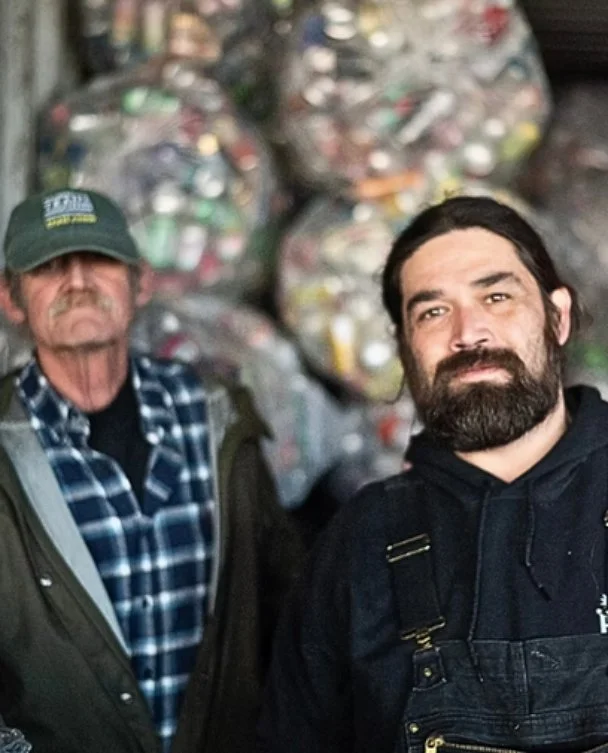
Kristofer Brown (right foreground), who has worked as a canner, manages the People’s Depot in Portland, Oregon. Photo by Mac Smiff.
In downtown Portland, The People’s Depot is also creating formal jobs with benefits for canners, and making use of their expertise.
Retailers in Oregon are mandated under DRS to accept a minimum number of containers daily per customer. Many, however, impose the minimum as a maximum. Although the deposit-refund doubled to 10 cents (USD) about a decade ago, many canners must bounce from store to store to earn enough in a day. A 2025 survey of canners, conducted by the depot’s parent NGO, Ground Score Association, found canners in the city had an hourly income of $7.68 — less than half of the official minimum wage.
Enter The People’s Depot, where 400 containers per customer are accepted — a restriction necessary due to limited space and brisk business. The depot offers other advantages, too, like speed and efficiency.
“Redemption can be clunky,” explains Operational Manager Kristofer Brown, who previously worked as a canner, “but it doesn’t have to be.”
Retailers, he says, often have too few employees dedicated to receiving containers, or they rely on reverse vending machines. The result is lineups. At The People’s Depot, recyclables are dumped into kiddie pools at up to six stations staffed by experienced canners. Counting and sorting goes quickly, because staff are so familiar with handling the materials and with the DRS rules.
“We understand a canner just spent hours collecting the containers,” Brown says, “and their time matters.” In fact, the survey of canners in Portland found they typically put in 30 or more hours each week.
That respect infuses everything The People’s Depot and Ground Score do. Ground Score also runs a free laundry and repair service that diverts five tons of textiles from the waste stream each month while supporting dignity and well-being. In another initiative, free studio space lets community members create upcycled art and crafts. To display and help sell the creations, Ground Score has instituted a monthly First Thursday Art Show. In January 2026, over 100 attendees bought $250 worth of art at the popular event.
Unlike their counterparts in New York and Québec, The People’s Depot receives no handling fee for containers. Instead, it is funded by a partnership with the distributors’ organization, Oregon Beverage Recycling Cooperative. Ground Score’s success and advocacy led Oregon to recognize alternative access redemption centres in a 2025 bottle bill update. Now, The People’s Depot will receive payments from retailers who benefit from having them nearby. In this way, Brown says, waste pickers have influenced legislation.
But canners still face an uphill battle in the court of public opinion.
In Portland, waste pickers are particularly stigmatized. Both the public and the media erroneously blame recycling income for fueling the city’s fentanyl crisis and crime. Ground Score has conducted surveys and provided research to counter these claims, but the myth persists.
This frustrates Brown, whose lived experience has shown him a different reality. “The more money you put in people’s pockets, the better decisions they make,” he says. Waste pickers he’s met — in Oregon and elsewhere — want two things: autonomy and respect.
“Treat us with respect, and we’ll return that tenfold.”
Recognize, Respect and Reward
That respect is vital for a just transition to a circular economy. Without it, waste pickers will continue to be marginalized, their contributions unrecognized and unrewarded, and their paths to formal employment overwritten by automation.
The rigorous work of seeking, collecting and redeeming beverage containers is an arduous business, paying far less than minimum wage and offering no benefits and plenty of risks. But there’s pride in the work, and a growing awareness among waste pickers that they play a vital part in changing how we’re wasting our world.
The three depots in this article are all affiliated with the North America Waste Pickers Alliance (NAWPA), part of an international movement of waste pickers who want their contributions to community and the environment recognized. Legislators in Canada and the United States can join this global movement by articulating a role for waste pickers in DRS, along with a clear path to integrating them into formal work.
“Respect is vital for a just transition to a circular economy.”