
Building the Foundation for Enduring Reuse
The New Container Design and Performance Standard — and Why it Matters
Imagine a world where reuse is so seamless it’s almost invisible.
You finish a delicious salad on the go, drop the reusable container into a nearby return bin, and never look back. Your empty refillable shampoo bottle goes to the curb in a reuse bin as easily as you roll out your trash.
This effortless reality of a robust reuse economy is powered by an enduring architecture of standards, ensuring reuse systems work consistently across every business and community. While you enjoy the convenience, these standards are the scaffolding allowing this future to exist.
That’s where PR3 comes in. A project of RESOLVE, PR3 has been leading the multi-stakeholder development of a set of six standards to undergird the growing reuse economy, creating what they term “a blueprint for efficient, reliable, economic, and environmentally beneficial reuse systems.” The standards are set by a global consensus body with over 80 organizations representing industry, government, and civil society.
Recently, PR3 and CSA Group announced the much-anticipated publication of the Container Design and Performance Standard — RES-001:26 / CSA R304:26 — a binational standard that sets design and performance requirements for reusable food, beverage, and consumer goods containers. Though all six standards work in an overlapping ecosystem, this one is particularly critical. Standardized container shapes, sizes, and materials are what allow reuse systems to interoperate and buy at market-shifting volumes — accelerating a future built on reuse.
This standard is why you’ll know you’re being handed a reusable salad container at the deli counter that is food-safe, clean, and durable. And the service provider circulating that container will know they’re getting a product that can be transported efficiently, washed thoroughly, and used at least 45 times.
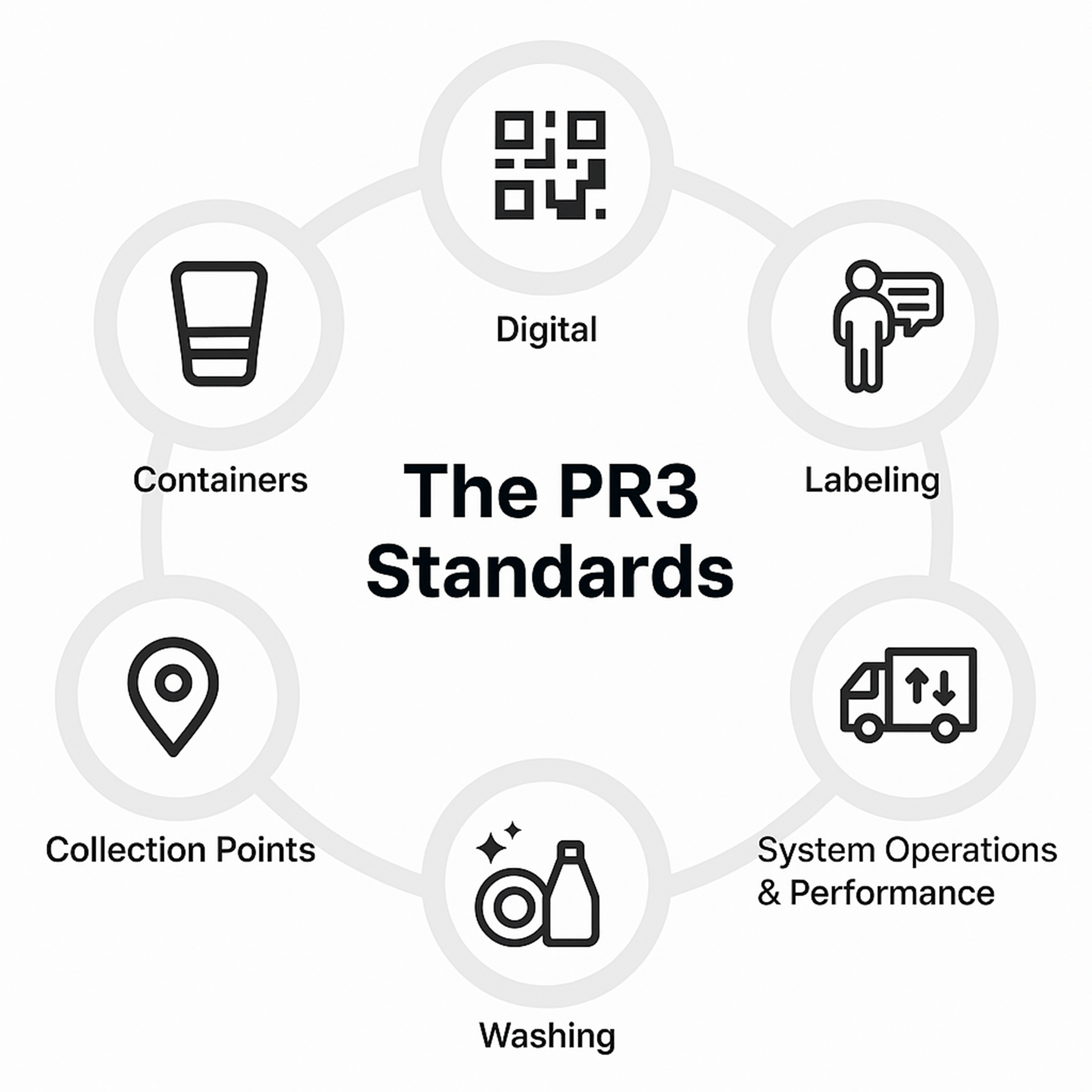
Image credit: PR3
First Things First: The Materials Elephant
The Container Design and Performance Standard was highly anticipated because it addresses one of the stickiest topics in the reuse movement: what should reusable containers be made of?
The Standard neither encourages nor discourages reusable containers to be made out of any specific material (e.g., stainless steel versus plastic). Rather, the materials guidance — found in Clause 5 of the Standard — disallows certain materials and chemical groups for reusable container production due to health and toxicity concerns. The list of restricted materials and chemical groups is derived from the peer-reviewed PlastChem report, “State of the science on plastic chemicals - Identifying and addressing chemicals and polymers of concern,” widely regarded as the gold standard of toxics research.
Additionally, while the Standard doesn’t prescribe using a specific material, it emphasizes “lightweighting” to achieve more efficient material use and fewer emissions from transportation. For example, reusable containers made from polypropylene are lighter, and thus more efficient to transport than those made from glass or stainless steel.
So… What’s the Answer?
The question of materials is a many-faceted topic — one to navigate thoughtfully without getting stuck in the quicksand of inaction. This Standard helps do that.
At Upstream, we believe the pathway to scaled reuse involves using materials that, while they may still be plastic, mitigate health and environmental concerns in the immediate term. The restrictions included in the Standard — specifically on PFAS and the other most pernicious chemical groups — bolster our confidence in the viability of this path.
Moreover, this is the path with the power to transform our economy and free us from the toxic status quo of a throw-away culture.
Creating a world where people and the planet are treated as indisposable requires us to take both the short and long view. We won’t simply wake up one day to this new world. And we shouldn’t have to wait until it’s fully realized to start experiencing its benefits. The single-use economy demands constant extraction — of resources, and of the communities living closest to where those resources are taken and discarded. Reuse is not a nice-to-have. It is the interruption of that exploitative cycle.
We are at a pivotal moment. Rapid scaling of reuse systems is what's needed to alleviate the burdens single-use packaging is placing across the full spectrum of human and ecological health.
The material choices we make today will either accelerate a genuine transition away from plastics, or delay it. Delay means keeping us on the current path — where plastics production is projected to more than double in the next 25 years. Deliberate choices to embrace safer plastics, as outlined in the Standard, lower the barrier to entry for rapid scaling of real reuse infrastructure for the needed transition — infrastructure that can ultimately eliminate 75% of single-use plastic production across a wide swath of consumer goods, takeaway food, and personal care products. Non-plastic materials alone cannot get us there fast enough.
The Fruits of Intentional Deliberation
The PR3 standards are a critical, high-integrity, shared foundation for the reuse movement. The Container Design and Performance Standard was over a year in the making, due to PR3’s intentional, iterative process that includes a public comment period. The Standard was informed by 100+ stakeholder groups from over 20 countries and arrived at through consensus, defined by RESOLVE’s PR3 Standards Development and Maintenance Program as “substantial agreement. Consensus implies much more than a simple majority, but not necessarily unanimity.” As PR3 states in the Standard, “It is consistent with this definition that a member may be included in the PR3 Panel list and yet not be in full agreement with all clauses of this Standard.”
Tension is inevitable in big social change movements. But ultimately, the reuse movement shares a vision of a climate-stable, healthy future free from waste and toxins. We must strategize how best to accelerate a petrochemical-free future while navigating imperfect building-block solutions along the way. It is clear that the working groups and Standards Panel in the PR3 process were having these deliberate and strategic conversations. The Design Standard sets strong, thoroughly-vetted parameters around material choice. We know it does not settle the question, but it helps the movement head in the same direction — even while there are multiple paths to getting there. The conversation will and must continue.
But Wait, There’s More
Though it is an important one, material selection is just one consideration among many in designing the most effective reusable containers. Questions of weight and durability; end-of-life recyclability; textures, seams, and angles that could interfere with washing and sanitizing; design for physical inventory management and transport (like nesting and collapsing); harmonized shapes and sizes; and more — all inform optimal container design.
“The new standards will enable reusable packaging companies, countries, and communities to re-create an un-throwaway world by utilizing the efficiencies and interoperability that standards provide”
The six PR3 Standards create the blueprint to move reuse from fragmented pilots into a robust and enduring industrial sector. By designing the means for shared infrastructure and enabling seamless interoperability between businesses and communities, these standards ensure that every link in the reuse chain is built for quality and long-term viability from day one.
As EPR packaging laws with reuse provisions gain momentum, these standards will have immediate real-world implications. Policymakers will be able to turn to a single set of guidelines to craft regulations around reusable packaging — and thanks to the Container Design and Performance Standard, producers will know exactly what kinds of container will work within a reuse system.
Even more immediate than EPR implementation, the sports and entertainment sector is currently — and increasingly — adopting reuse systems in stadiums and arenas. With an eye toward the FIFA World Cup and LA28 Olympics, Upstream produced a model Request for Proposals (RFP) for reuse service provision that decision makers at venues can adapt for their use. We include the Container Design and Performance Standard in the appendices of the RFP to ensure that future vendors comply with the Standard.
This is How We Get to Scaled Reuse
One point we can’t overemphasize? The Container Design and Performance Standard is intended for containers that operate within a system. We think about design differently when we are thinking systemically. And this is why standards are so critical for scaling reuse.
Systems thinking is what differentiates the reuse economy from the single-use economy. In the reuse economy, packaging becomes a service, not a product — and with many touchpoints from service provider to consumer and back again, reusable packaging is the center of interactivity. Its starring role in reuse systems necessitates a level of design consideration far beyond that of single-use. All so that we — the deli salad and shampoo consumers — don’t have to think about it at all.