
Why Policy Matters for Reuse Service Providers
And what RSPs, policymakers, and Upstream are doing about it
Why should reuse service providers care about policy? And why should policymakers care about reuse service providers? Reuse companies are a private sector enterprise, after all, and government is meant to serve the public good.
But the reality isn’t quite that binary — because reuse systems are good for everyone. They create jobs, prevent litter and pollution, and support healthy, resilient communities. We are at a tipping point where we must bend the curve on single-use waste by rapidly scaling reuse systems — and this is where public and private interests coincide.
Without reuse service providers (RSPs), we face a fragmented transition to reuse systems and limited progress toward achieving a circular economy at scale.
RSPs have been enabling reusable packaging in business to business (B2B) transactions for decades. While B2B opportunities continue to expand, a new cohort of reuse companies is also growing. RSPs focused on consumer-facing packaging and foodware emerged to offer essential expertise and utility to restaurants, venues, institutions, and corporations.
Collectively, RSPs are building a new and rapidly expanding sector of the economy. As with any new market, they need a supportive and intentionally crafted policy environment to grow and thrive. Which means policymakers and advocates must understand the challenges RSPs face so they can deploy policy levers that will help the reuse industry — and its impact — expand.
In so doing, policymakers strengthen a critical pathway for accelerating the transition from single-use to reuse — a transition that will deliver crucial environmental, economic, and social benefits for everyone.
Let’s Talk About It
As a neutral third-party convener with a strategic eye toward growing and supporting the reuse industry, Upstream saw an opportunity to help harmonize reuse efforts and get key players pulling in the same direction. So, throughout 2025, we facilitated a multi-stakeholder dialogue series centered around RSPs. With input from partner nonprofit organizations and government agency staff with experience in reuse policy development, RSPs worked together to identify and coalesce around a set of policies that best support the growth of their sector.
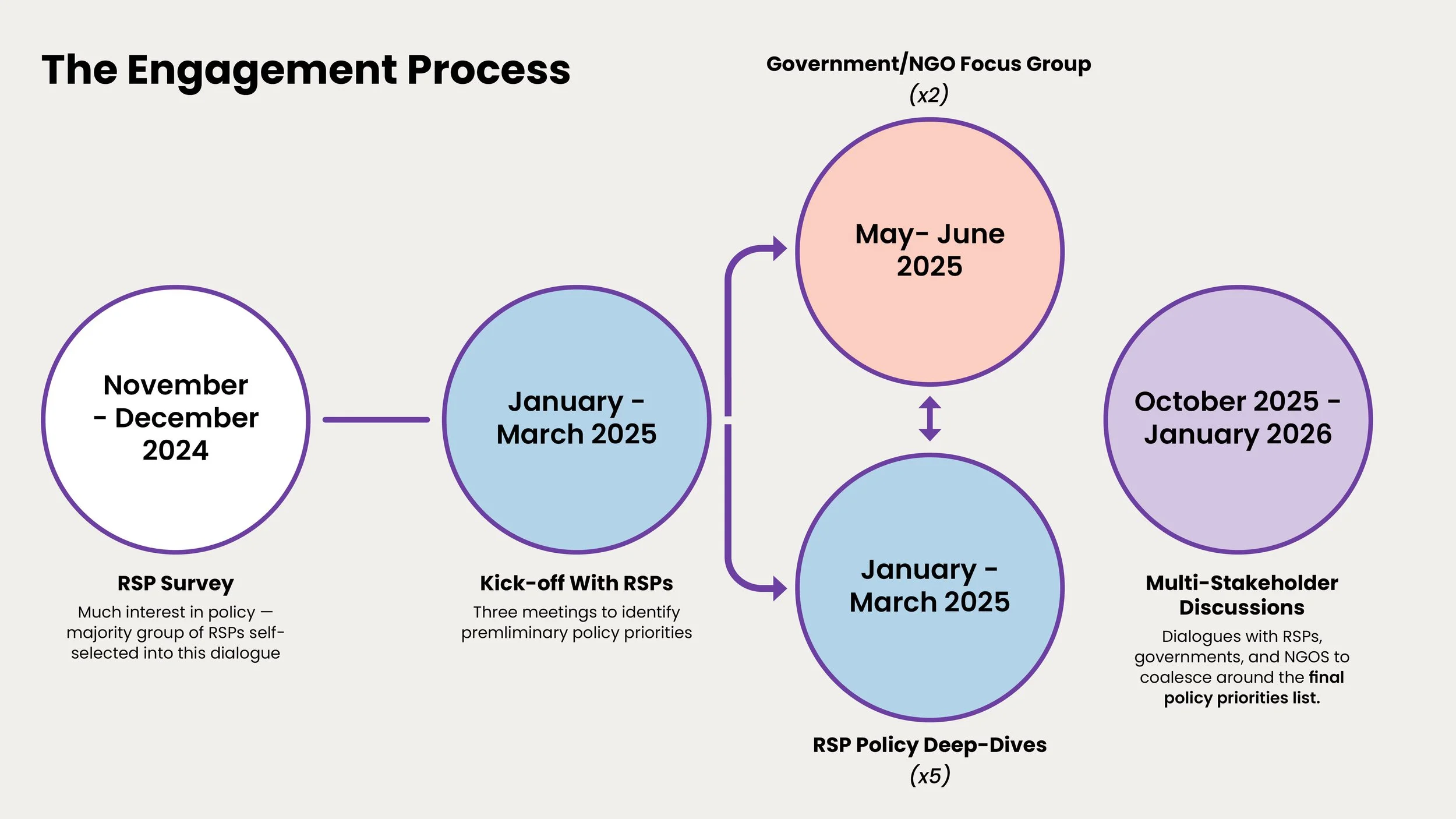
This dialogue series began in late 2024, when Upstream sent RSPs across the United States and Canada a survey to better understand their shared obstacles and policy needs. They shared many challenges and experiences, yet also had varying perspectives on which policies could best support them — and how. Regardless, 90% of respondents were interested in joining a focus group to develop a cohesive set of policy principles for reuse service providers.
That self-selected group engaged in three discussion-based dialogues, during which RSPs explored different policy options and came up with a preliminary list they felt could help their growth.
But these were business leaders, not necessarily policy experts. In order to create the strongest priority list possible, the RSPs needed a deeper dive into the complexities of reuse policy making. So, over the course of five informational sessions, we explored topics including extended producer responsibility (EPR), grants and rebates, disposable cup/container charges, reuse at events, and policy engagement.
Separate Pathways to Bring Everyone Together
On a parallel track, Upstream engaged government agencies and nonprofit affiliates — experts familiar with waste reduction and reuse legislation — in two focus group sessions. We knew their insights about the political nuances of the policies the RSPs were considering would strengthen the final list of priorities. So we gathered feedback on the potential considerations and limitations of these policies, which we then presented to the RSPs.
By convening separate meetings, we built a sort of “conflict mediation” structure in which we were able to act as a go-between, ultimately enabling more productive discussions for both groups. Though at the end of the day both groups want to see reuse thrive, we identified gaps between their goals, assumptions, and priorities. One of our own goals with this dialog series was to bridge that gap.
For example, governments tended to emphasize that RSPs need to have a viable business model to sustain themselves. RSPs highlighted their role in supporting several sustainability goals in municipalities, asserting their need for up-front support to grow consumer demand before they're fully at scale. RSPs also noted that they prefer state or provincial level policies over local ones. This is partly to address patchworks in policy which can make enforcement and implementation tricky. Meanwhile, governments identified local policies as often paving the way for state and provincial level policies.
We were not seeking full consensus, and productive disagreement lingers. But through this iterative, mediated feedback process, we were able to get the two groups on the same page and sharing a broader policy vision. The series culminated in a final facilitated three-part dialogue in which RSPs, nonprofit organizations, and government agencies were all brought together for the first time. After completion of the series, RSPs agreed on a list of policy priorities they felt could increase opportunities for reuse service businesses in the consumer packaged goods and food service sectors.
The List
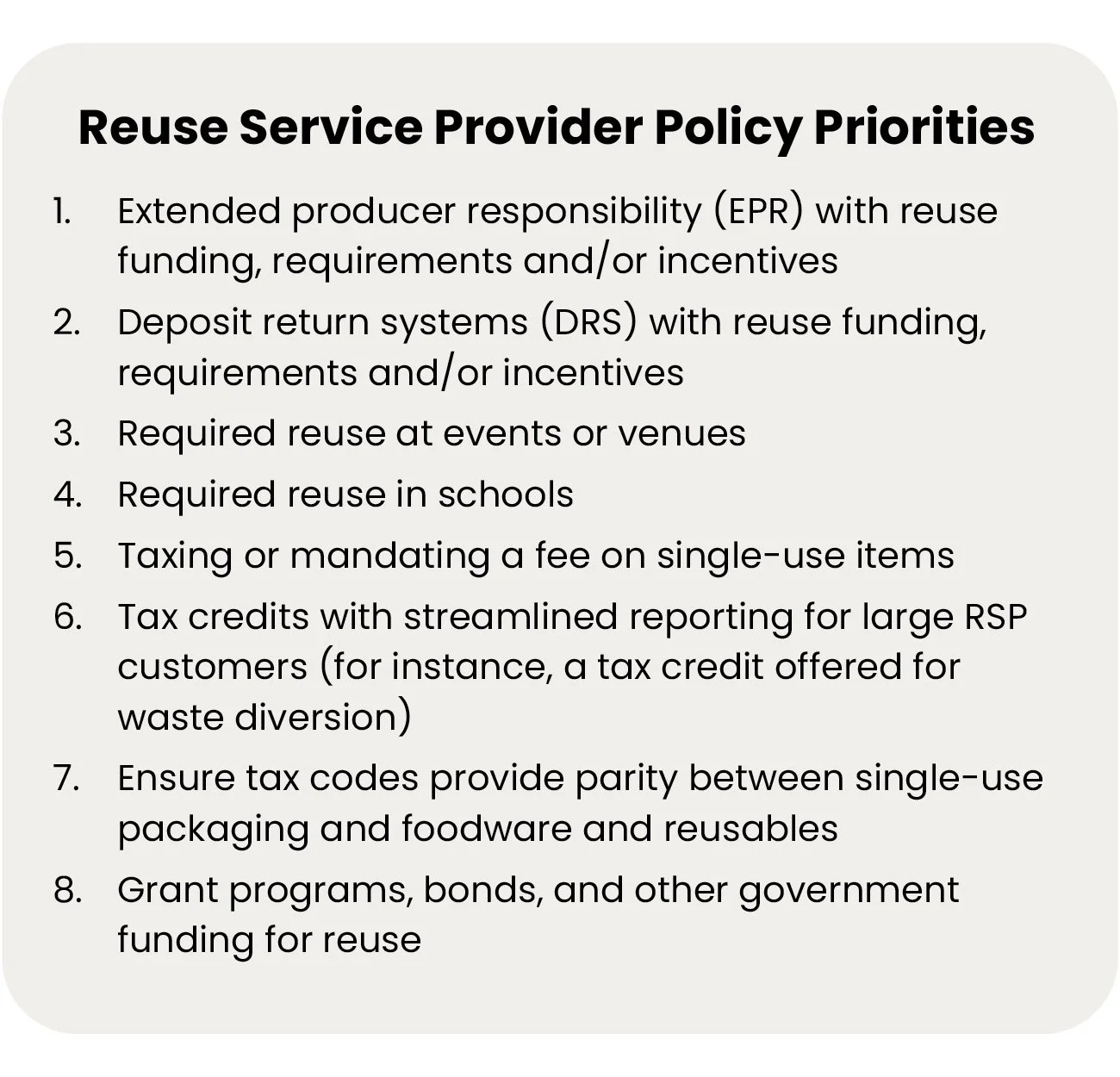
So, what did participants conclude are the best policies to advance to support RSPs? They agreed upon a high-level list — recognizing that details are best left to each jurisdiction and circumstance. The full list — in no order of priority — includes extra information about each recommendation.
Extended producer responsibility (EPR) with reuse funding, requirements and/or incentives
Deposit return systems (DRS) with reuse funding, requirements and/or incentives
Why EPR and DRS? EPR and DRS are proven policies that have been enacted worldwide and have vast potential for accelerating reuse. When reuse incentives and targets are written into the policy, they catalyze real-world scaling by creating demand. In addition, fees collected from these laws provide needed capital for reuse infrastructure. With legislative momentum growing around both of these policies, we face a key window of opportunity to integrate reuse into them. Upstream recommends passing EPR and DRS together whenever possible.
3. Required reuse at events or venues
4. Required reuse in schools
Why required reuse? Mandating reuse in large, highly-frequented settings like entertainment venues and schools drives demand. It also compels risk-averse stakeholders to engage with reuse service providers. From their experiences, RSPs confirmed that once stakeholders see the ease of the process and start accruing savings, the dynamic changes rapidly. Also, exposing broad swaths of the public, including schoolchildren, to reuse systems normalizes the practice, socializes circular thinking, and opens the door for more widespread adoption.
5. Taxing or mandating a fee on single-use items
6. Tax credits with streamlined reporting for large RSP customers (for instance, a tax credit offered for waste diversion)
7. Ensure tax codes provide parity between single-use packaging and foodware and reusables
Why taxes, fees, and credits? In many areas, single-use items, particularly plastics, are subsidized or even incentivized in pricing and taxation schemes — making them the default choice because they are so (artificially) inexpensive. Some tax codes even exempt taxation on single-use foodware while taxing reusables. Taxes, fees, credits, and code corrections can all help correct the market while potentially offering price advantages for reusables — thus driving demand.
8. Grant programs, bonds, and other government funding for reuse
Why grants and funding? Grants and bonds can help RSPs during their startup phase, expanding their customer base, offsetting startup costs, and supporting infrastructure. Currently, RSPs are not inherently eligible for many of the general sustainability grants offered by governments. In light of the many economic, social, and environmental advantages that reuse offers, these eligibility requirements should be expanded.
Some common reuse policies — like required reuse for onsite dining — are absent from this list. That’s because these policies do not necessarily result in more customers or increased revenue for RSPs. Of course, they are still important for normalizing reuse and reducing waste and pollution, but they fall beyond the scope of these dialogues.
By identifying what can directly help RSPs expand their customer base and scale their operations, we hope to help U.S. and Canadian governments support this emerging industry — and in turn, a full transition to a reuse economy.
What’s Next?
Upstream had several intentions before launching this dialogue series. We aimed to build consensus around the policies that best support the RSP sector, and to support a stronger alliance between RSPs, nonprofit entities, and government affiliates — all in the interest of driving collective action and impact through a shared policy agenda.
In the end, participants strongly agreed that facilitated discussions helped them better understand one another’s perspectives and learn collaboratively. And the resulting shared understanding of policy enables RSPs, nonprofit organizations, and government agencies to more effectively advocate for and pass reuse policies within their own municipalities.
Most importantly? The dialogues opened pathways for communication and mutual understanding that will only strengthen the reuse movement as a whole. Participants wholeheartedly agreed they would like to continue dialogues into the future — to further refine policies, address other challenges and barriers, and to continue working together toward an enduring reuse economy.